
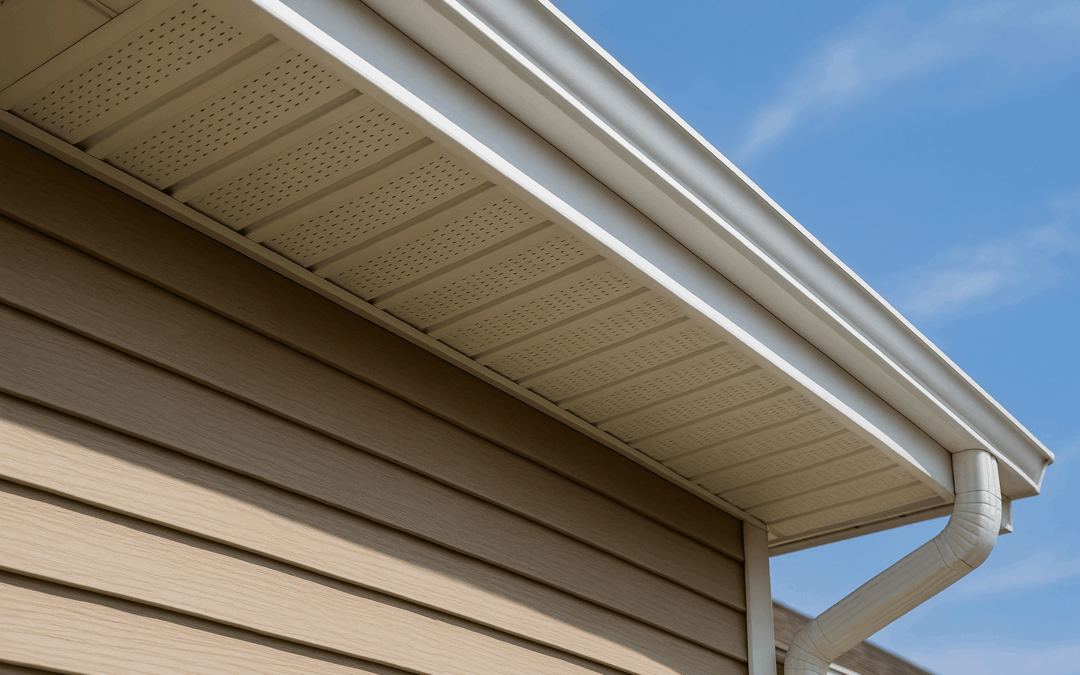
Louisville, Kentucky homeowners considering exterior renovations or replacing deteriorated roofline materials frequently encounter vinyl soffit as an option for the underside of their roof overhangs. As a material that has largely replaced wood soffit in new residential construction and renovation across the Ohio Valley region, vinyl soffit brings specific performance characteristics that are relevant to Louisville’s four-season climate. Cardinal Gutters believes that Louisville-area homeowners deserve a thorough, informational understanding of vinyl soffit—what it is, how installation works, what advantages it offers in Louisville’s specific climate, and what practical considerations homeowners should understand before making soffit material decisions.
What Vinyl Soffit Is
Vinyl soffit refers to panels manufactured from polyvinyl chloride (PVC) designed to cover the underside of roof overhangs—the horizontal surface enclosed beneath the eaves between the exterior wall and the fascia board at the roof edge. These panels are available in solid configurations for areas where air passage is not needed and in perforated or vented configurations that allow outside air movement into the attic space below, serving the ventilation function that building science and building codes require of soffit systems.
Vinyl soffit panels interlock along their long edges and install using a channel-based mounting system—J-channel or F-channel trim pieces secured to the wall face and fascia board create receiving tracks into which panel edges slide. This installation system holds panels securely while accommodating the thermal expansion and contraction that vinyl experiences between Louisville’s cold winters and hot summers. The color of vinyl soffit is integrated throughout the panel material during manufacturing, meaning the product does not require field painting to maintain its appearance or moisture resistance.
Available in numerous profiles including smooth face, beaded, and woodgrain textures, and in a range of colors predominantly centered around whites and neutral tones, vinyl soffit integrates visually with complementary vinyl fascia wrap, siding, and trim products to create cohesive roofline appearances on renovated and new-construction homes throughout Louisville’s residential neighborhoods.
Louisville’s Four-Season Climate and Soffit Performance Demands
Louisville’s position in the Ohio River Valley creates a climate of pronounced four-season character—warm and wet springs, hot and humid summers, colorful and debris-heavy autumns, and winters with regular freeze-thaw cycling. Annual precipitation averages approximately 45 inches, distributed throughout the year with spring delivering the most intense rainfall. High Ohio Valley humidity throughout the warm months means exterior materials face sustained moisture exposure conditions, and the region’s diverse hardwood tree canopy creates substantial organic debris that challenges gutter performance and contributes to soffit moisture exposure through gutter overflow events.
Wood soffit in Louisville’s climate faces a well-documented deterioration progression. Ohio Valley humidity maintains elevated moisture content in wood panels between rainfall events. Frequent spring rainfall provides direct moisture loading. Warm temperatures support the biological activity that converts moist wood into decayed wood. Louisville’s winter freeze-thaw cycling causes paint films to crack through repeated dimensional cycling, allowing moisture access that progressively exposes larger wood areas to direct contact. UV degradation during summer shortens the effective service life of exterior paint. The combined result is that wood soffit in Louisville requires recurring painting maintenance and develops rot within years without consistent attention—a maintenance burden that vinyl soffit’s material properties largely eliminate.
Installation Overview
Vinyl soffit installation begins with thorough preparation of the installation area. In replacement projects, existing deteriorated wood soffit is removed and the underlying framing is inspected carefully. Any moisture damage, pest damage, or structural weakness in nailer boards or lookout framing is addressed before new soffit installation begins. Installing new soffit material over compromised framing produces poor results and may conceal ongoing structural deterioration—preparation thoroughness directly affects installation quality and longevity.
Channel trim installation follows framing preparation. J-channel or F-channel pieces are secured along the wall face at the interior soffit edge and along the fascia board at the exterior edge, creating the receiving tracks into which soffit panel edges will fit. These channel pieces must be installed level, plumb, and at consistent positioning to ensure that completed soffit panels sit flat and uniform. Channel installation quality establishes the geometry that all subsequent panels must conform to—errors at this stage propagate through the entire installation.
Soffit panels are measured and cut to span the distance between wall channel and fascia channel, then inserted into the channels and interlocked with adjacent panels as installation progresses. Face-nailing through the panel’s nailing hem secures each panel to soffit framing, with the adjacent panel’s interlocking edge covering the fastener. An important installation detail is that panels must not be cut too tightly or installed in channels that bind their edges without allowance for thermal expansion. Louisville’s temperature range—from winter lows below freezing to summer highs in the 90s Fahrenheit—creates significant thermal movement in vinyl panels, and installations that prevent this movement develop buckling and visual distortion.
Vented versus solid panel distribution requires deliberate planning. Attic ventilation calculations based on attic floor area and roof pitch determine the minimum net free ventilation area required, and the distribution of vented panels through the soffit must achieve this area while distributing airflow appropriately along the soffit run rather than concentrating ventilation in limited sections.
Advantages Vinyl Soffit Offers Louisville Homeowners
Moisture Non-Absorption: PVC does not absorb water. This single property eliminates the fundamental deterioration mechanism—moisture absorption leading to rot—that makes wood soffit maintenance-intensive in Louisville’s wet, humid climate. Vinyl panels that get wet during gutter overflow events or wind-driven rain dry completely without retaining moisture in the material.
No Repainting Requirement: Vinyl soffit’s factory-integrated color eliminates the periodic exterior painting maintenance cycle that wood soffit requires in Louisville’s climate. Over the decades-long service life of a home’s soffit system, eliminating painting cycles represents meaningful cumulative cost and labor savings while ensuring the material maintains moisture resistance independently of paint condition.
Resistance to Biological Deterioration: Vinyl provides no nutritional value to wood-decaying fungi, mold organisms, or wood-boring insects. Carpenter bees that bore into wood soffit cannot damage vinyl panels. This biological inertness is particularly relevant in Louisville’s warm climate, where both fungal activity and insect activity are sustained throughout the warmer months.
Dimensional Stability in Moisture Conditions: Unlike wood, which expands when wet and contracts when dry—creating mechanical stress on paint films and joint sealants—vinyl soffit maintains consistent dimensions in varying moisture conditions. This dimensional stability reduces the joint and surface movement that causes deterioration in moisture-cycling environments.
Freeze-Thaw Resilience: Vinyl soffit properly installed with appropriate thermal expansion allowances performs well through Louisville’s repeated winter freeze-thaw cycles without the paint cracking and moisture infiltration progression that affects wood soffit during the same conditions.
Pest Exclusion Maintenance: Vinyl soffit’s physical integrity as a pest exclusion barrier remains more consistent over time than wood soffit, which develops pest access points as deterioration progresses. Maintaining intact pest exclusion at the soffit level is important for preventing bird, bat, squirrel, and wasp access to the attic space—a concern in Louisville’s wildlife-rich Ohio Valley environment.
Considerations Worth Understanding
Vinyl soffit has characteristics beyond its advantages that informed homeowners should understand. Louisville’s occasionally severe hail events can damage vinyl soffit panels, and panel replacement requires matching existing profile, color, and product specifications—which can be challenging if original products have been discontinued. Physical impact from falling tree branches or ladder contact can crack vinyl panels in ways that require section replacement.
Vinyl soffit’s appearance in direct sunlight differs from painted wood—some homeowners prefer the visual character of wood materials and find vinyl’s uniform appearance less appealing on certain architectural styles. For homes in Louisville’s historic neighborhoods or districts with architectural review requirements, vinyl soffit may not be appropriate under applicable preservation guidelines, and homeowners should verify requirements before selecting materials for roofline renovation.
Very low temperatures make vinyl more brittle than at moderate temperatures. While Louisville’s winters are not extreme by northern standards, this characteristic is worth noting for installation timing and impact vulnerability during cold periods.
Conclusion
Vinyl soffit is a widely applicable and climate-appropriate roofline material for Louisville, Kentucky homes, offering moisture resistance, maintenance reduction, biological inertness, and pest exclusion durability that address the specific deterioration pressures Louisville’s Ohio Valley climate creates for exterior wood materials. Cardinal Gutters recognizes that Louisville-area homeowners benefit from understanding what vinyl soffit is, how it is correctly installed, what genuine advantages it provides in Louisville’s four-season climate, and what practical considerations affect material selection and installation quality decisions. For homes throughout Louisville facing the combined challenges of Ohio Valley humidity, substantial annual rainfall, winter freeze-thaw cycling, and active biological and pest environments, vinyl soffit’s material properties represent a meaningful and well-documented improvement over painted wood soffit for homeowners seeking reduced maintenance demands and durable roofline protection.