Louisville, Kentucky homeowners investing in exterior improvements or addressing deteriorating components often encounter recommendations for vinyl soffit without fully understanding what this material is or why it has become the predominant choice for residential soffit applications. This synthetic material has largely supplanted traditional wood soffit in modern construction and renovation, yet its characteristics, benefits, and limitations remain unclear to many property owners. Cardinal Gutters regularly provides Louisville-area homeowners with education about vinyl soffit—what it is, how it performs in regional climate conditions, and what advantages and drawbacks it presents. Thorough understanding of vinyl soffit empowers homeowners to make well-informed decisions about this important yet often-overlooked exterior component.
Defining Vinyl Soffit
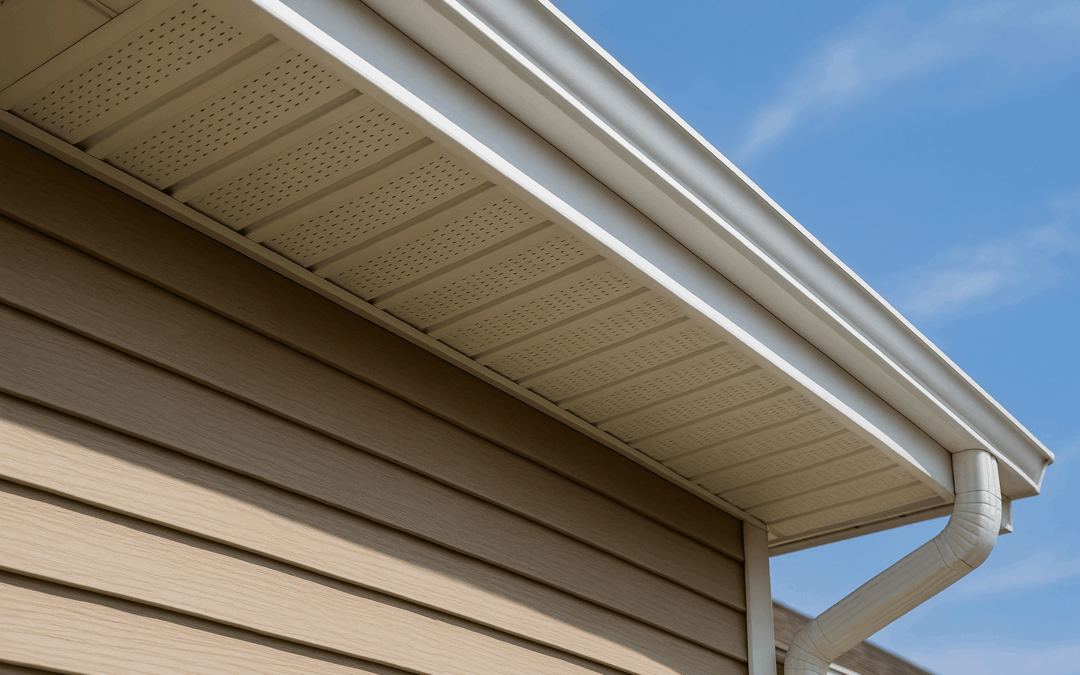
Soffit refers to the finished surface installed on the underside of any overhanging architectural element, most commonly the horizontal area beneath roof eaves where roofs project beyond exterior walls. Looking upward from outside your home at the eaves, the material spanning between the exterior wall and the fascia board is the soffit. Vinyl soffit describes this component when manufactured from polyvinyl chloride (PVC) plastic materials rather than traditional wood, aluminum, or fiber cement alternatives.
Vinyl as a building material emerged in the residential construction industry during the 1960s as manufacturers developed synthetic alternatives to wood products requiring intensive maintenance. Vinyl soffit production involves extrusion manufacturing where PVC resin is heated and forced through precision dies that shape the molten material into specific profiles. Once cooled, the continuous extrusions are cut to standard lengths creating uniform panels. Color pigments and UV stabilizers are integrated into the material during manufacturing, eliminating the need for painting and reducing color fading over time.
Like all soffit materials, vinyl serves dual purposes. Aesthetically, it provides finished appearances concealing structural elements like roof rafters, trusses, and the underside of roof decking that would otherwise remain exposed. This contributes significantly to overall curb appeal and creates professional, complete exterior appearances. Functionally, vinyl soffit seals the transition between roof structures and exterior walls, blocking access points that would otherwise allow birds, squirrels, bats, raccoons, and insects to enter attic spaces. Most critically, perforated vinyl soffit facilitates essential attic ventilation by allowing fresh air to enter at the eaves, which then exits through ridge vents or gable vents, creating beneficial air circulation that reduces heat accumulation and controls moisture levels.
Vinyl soffit is manufactured in several configurations. Solid panels without perforations provide weather protection without ventilation, suitable for areas like porch ceilings or situations where attic ventilation occurs through other means. Fully perforated panels feature ventilation holes across entire surfaces, maximizing airflow. Partially perforated panels include ventilation strips surrounded by solid sections, balancing airflow with structural appearance. Common panel widths include twelve-inch and sixteen-inch configurations, with lengths typically ranging from twelve to twelve-and-a-half feet.
Vinyl Soffit Advantages in Louisville’s Climate
Louisville’s humid subtropical climate creates conditions where vinyl soffit characteristics offer distinct benefits compared to traditional materials. The city experiences hot, humid summers with July temperatures averaging in the mid-80s and relative humidity frequently exceeding 70%. Winters bring cold temperatures, precipitation including snow and ice, and freeze-thaw cycling. Louisville receives approximately 45 inches of annual precipitation distributed throughout the year, creating consistent moisture exposure for all exterior building components.
Vinyl’s primary advantage lies in complete moisture impermeability. Unlike wood, which absorbs water leading to swelling, warping, and eventual rot, vinyl is unaffected by moisture. It will not absorb water, cannot rot or decay, and provides no substrate for biological organisms like mold, mildew, or wood-decay fungi. In Louisville’s moisture-rich environment where wood products historically deteriorate rapidly, vinyl’s resistance to water-related damage represents a significant practical benefit.
Maintenance requirements for vinyl soffit are minimal compared to wood alternatives. Wood soffit demands regular painting or staining every 5-10 years depending on exposure and product quality. It requires periodic inspection for rot and damage, with prompt repairs necessary when problems appear. Vinyl eliminates these requirements. It never needs painting because color is integral to the material. While vinyl can accumulate surface dirt or develop superficial mold growth, simple washing with household detergent typically restores appearance without labor-intensive preparation and painting.
Vinyl resists pest damage that commonly affects wood soffit in Louisville. Carpenter bees, prevalent throughout Kentucky, cannot bore into vinyl to create nesting galleries. Termites find no nutritional value in plastic materials. Woodpeckers make no progress excavating synthetic surfaces. This immunity to insect and animal damage provides lasting protection without the vigilance and intervention wood materials require.
Economic factors favor vinyl in most residential applications. Material costs for vinyl soffit generally run lower than wood, aluminum, or fiber cement alternatives. Installation costs are typically comparable or lower due to vinyl’s lightweight characteristics and straightforward installation processes. Long-term economics favor vinyl even more dramatically when considering eliminated painting costs, reduced repair requirements, and extended service life compared to wood.
Understanding Vinyl Soffit Limitations
Despite substantial advantages, vinyl soffit has limitations Louisville homeowners should understand before making material decisions. Temperature extremes affect vinyl differently than traditional materials. High heat can make vinyl somewhat pliable, potentially causing sagging in panels that were over-fastened during installation or lack adequate support. While Louisville’s summer temperatures rarely reach levels truly dangerous for vinyl, prolonged direct sun exposure on dark-colored panels can occasionally create localized softening.
Cold temperature effects present greater practical concerns. Vinyl becomes brittle when frozen, making it vulnerable to cracking if impacted during winter months. Louisville winters periodically bring temperatures into the teens or occasionally single digits—cold enough to induce brittleness. Impacts from ladders, falling tree branches, ice accumulation, or hail during these cold periods can crack panels that would resist identical impacts during warmer weather.
Thermal expansion and contraction occur more dramatically in vinyl than most other building materials. Louisville’s temperature range between summer highs and winter lows can cause vinyl panels to expand and contract by half an inch or more across a twelve-foot length. Proper installation must accommodate this movement through appropriate expansion gaps and correct fastening techniques. Improperly installed vinyl may buckle during thermal expansion or pull free from mountings during contraction cycles.
Color options, while reasonably varied, are more limited than unlimited paint color selections available for wood or fiber cement. Additionally, vinyl colors cannot be changed—they’re molded into the material permanently. If homeowners tire of existing colors or want to update exterior color schemes, complete replacement is the only option. While modern vinyl formulations include UV inhibitors that substantially reduce fading, some color change inevitably occurs over decades, particularly with darker colors that absorb more solar radiation.
Aesthetic considerations matter for some properties. While vinyl can be textured to simulate wood grain patterns, close examination reveals its synthetic nature. For Louisville’s historic properties or homes in preservation districts where maintaining period-appropriate authentic materials affects property values and regulatory compliance, vinyl’s obviously artificial appearance may be inappropriate or even prohibited.
Environmental concerns surround vinyl production and disposal. PVC manufacturing involves chemical processes with documented environmental impacts. At end of service life, vinyl soffit contributes to landfill waste, though recycling infrastructure for vinyl building materials continues developing.
Proper Vinyl Soffit Installation
Correct installation proves critical for vinyl soffit performance and longevity. Unlike wood soffit that can be nailed firmly in position, vinyl requires installation techniques that accommodate thermal movement. Fasteners must be positioned in the centers of nailing slots rather than at slot ends, allowing panels to shift as they expand and contract. Fasteners should not be driven tightly—leaving approximately 1/32 inch clearance between fastener heads and panel surfaces allows necessary movement.
Expansion gaps must be maintained wherever vinyl panels meet trim pieces, J-channels, or other accessories. Generally, 1/4 inch gaps accommodate typical seasonal movement, though this increases for installations during cold weather when panels are contracted and decreases for installations during hot weather when panels are already expanded. Louisville’s temperature extremes demand careful attention to these installation details.
Ventilation area calculations ensure adequate attic airflow meeting building code requirements. Standard codes typically require one square foot of net free ventilation area per 150 square feet of attic space, with balanced intake (soffit) and exhaust (ridge or gable) ventilation. Selecting appropriate perforated soffit configurations and ensuring adequate coverage provides compliant ventilation supporting roof longevity and energy efficiency.
Vinyl Soffit Maintenance and Care
Vinyl soffit maintenance focuses primarily on periodic cleaning and inspection rather than intensive upkeep. Louisville’s humidity promotes biological growth on all exterior surfaces. Annual or biannual washing with mild soap solutions removes mold, mildew, dirt, pollen, and environmental deposits. Soft brushes or gentle pressure washing effectively cleans vinyl without causing damage, though excessive water pressure should be avoided to prevent forcing water behind soffit panels into attic spaces or damaging interlocking panel edges.
Regular inspections identify developing problems before they become serious. Check for loose panels, separation from mounting systems, or damage, particularly following severe weather events. Verify that perforated panels remain clear and unobstructed by insect nests, accumulated debris, or inadvertent paint overspray from other projects. Examine areas where soffit meets trim, walls, or fascia for gaps that might allow pest entry or water infiltration.
Repairs typically involve replacing damaged individual panels rather than attempting to fix broken vinyl. The interlocking design usually allows removing and replacing specific panels without disturbing surrounding sections. Maintaining extra panels from original installation enables exact color and profile matching, important because manufacturers occasionally discontinue specific products.
Vinyl Soffit Compared to Alternative Materials
Vinyl soffit characteristics become clearer through comparison with other available materials. Wood soffit offers natural beauty, authentic appearance, and unlimited color options through painting but requires substantial ongoing maintenance, remains vulnerable to moisture damage and insect infestation, and ultimately costs more when long-term maintenance is factored into total ownership expense. Aluminum soffit provides excellent durability, superior fire resistance, and exceptional weather performance without any painting requirements but costs substantially more initially and can dent from hail or physical impacts. Fiber cement soffit combines authentic appearance with excellent durability and paintability but weighs significantly more than other options, costs considerably more, and requires periodic repainting like wood.
Vinyl occupies a practical middle position—more durable and far lower maintenance than wood, much more affordable than aluminum or fiber cement, but with aesthetic limitations and temperature sensitivity that premium materials don’t share. For most Louisville homeowners prioritizing practical performance, affordability, and minimal maintenance over authentic materials or absolute premium durability, vinyl offers an appropriate balance.
Conclusion
Vinyl soffit has become the predominant choice for residential soffit applications throughout Louisville, Kentucky, and the surrounding region, offering homeowners practical combinations of affordability, durability, and minimal maintenance requirements. Cardinal Gutters understands that Louisville-area property owners who comprehend vinyl soffit’s characteristics, benefits, and limitations can make better-informed decisions regarding new construction specifications, renovation material selections, or soffit replacement projects. While vinyl may not suit every application—particularly historic restorations requiring authentic materials or premium properties demanding highest-quality components—its moisture resistance, pest immunity, and minimal maintenance needs make it appropriate for most residential applications throughout the Louisville area. Whether planning new construction, replacing deteriorated wood soffit, or simply seeking to understand existing home components better, knowledge about vinyl soffit performance in regional climate conditions supports wise property stewardship and investment decisions.