
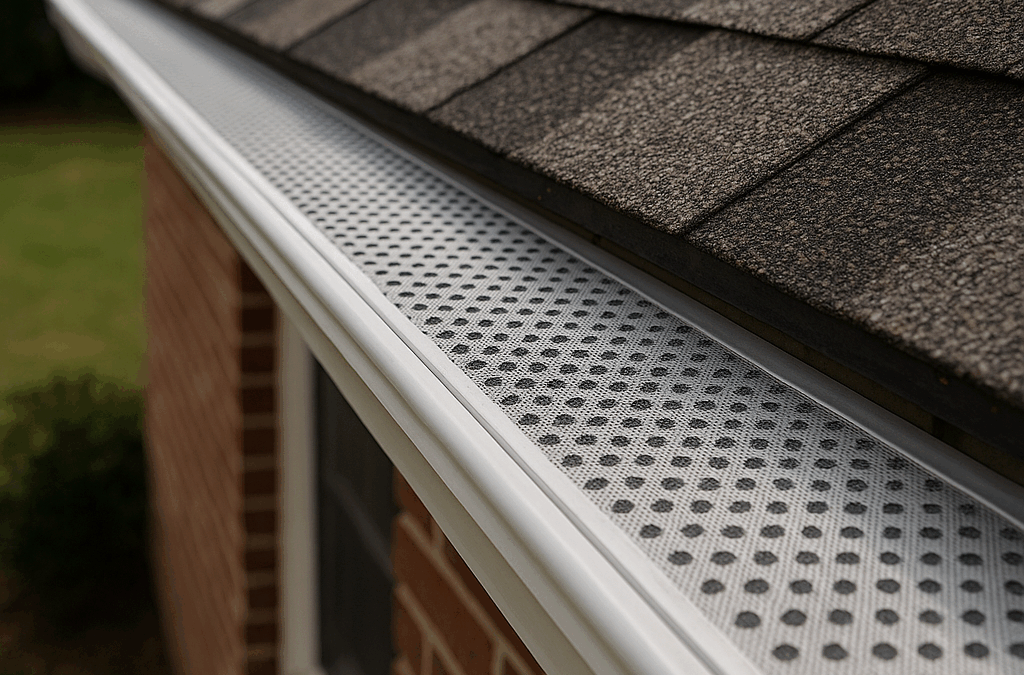
For homeowners in Louisville, Kentucky, the question of whether to install gutter guards represents a significant decision in home maintenance strategy. Cardinal Gutters serves the Louisville area, where the combination of deciduous tree coverage, variable weather patterns, and the region’s characteristic humidity creates unique challenges for gutter system maintenance. Understanding what gutter guards are, how different types function, and their respective advantages and limitations enables property owners to make informed decisions about protecting their investment.
What Are Gutter Guards?
Gutter guards, also called gutter covers or gutter protection systems, are devices installed over or inside gutters to prevent debris from entering while allowing water to flow through. The fundamental concept is simple: create a barrier that leaves, twigs, seed pods, and other materials cannot penetrate, while ensuring rainwater can still access the gutter channel and flow to downspouts.
The reality proves considerably more complex than this basic principle suggests. Debris comes in countless forms—from large oak leaves to tiny pine needles, from helicopter seeds to shingle granules. Water arrives at different rates and from various angles depending on roof pitch, rainfall intensity, and wind conditions. No single gutter guard design optimally addresses every variable, which explains why numerous types exist, each with specific strengths and weaknesses.
Types of Gutter Guard Systems
Screen gutter guards represent the most basic and affordable option. These guards consist of metal or plastic mesh screens that sit atop gutters, blocking larger debris while allowing water to pass through the perforations. Metal screens, typically aluminum or stainless steel, offer better durability than plastic versions. The effectiveness depends largely on hole size—larger openings allow more debris passage but handle water volume better, while smaller holes provide superior debris blocking but may struggle with heavy rainfall.
Mesh gutter guards feature very fine perforations, often made from surgical-grade stainless steel or similar materials. The micro-mesh design blocks even small debris like shingle granules and pine needles while theoretically allowing water through via surface tension. Quality mesh guards typically involve a more substantial frame and more sophisticated installation than basic screens, with correspondingly higher costs.
Reverse curve (or surface tension) guards employ a principle where water adheres to a curved surface and follows it into the gutter while debris slides off the edge. These systems create a rounded hood over the gutter with a narrow opening at the front edge. Water sheets down the roof, clings to the curve, and turns into the gutter slot. Leaves and larger debris theoretically maintain momentum and fall to the ground.
Foam gutter inserts fill the gutter channel with porous foam that allows water to permeate while blocking debris from entering. The foam sits inside the gutter rather than covering the top. Water filters through the foam material and flows along the gutter bottom to downspouts. Debris rests on top of the foam where it theoretically dries and blows away.
Brush gutter guards consist of large bristle-filled cylinders that sit inside gutters. The bristles point upward, allowing water to flow around them while catching leaves and debris above the gutter bottom. The concept resembles a bottle brush inserted into the gutter channel.
How Louisville’s Climate Affects Performance
Louisville receives approximately 45 inches of precipitation annually, distributed fairly evenly throughout the year but with slightly higher rainfall during spring months. The frequency and intensity of rain events affect how well different guard types perform. During heavy thunderstorms, water volume can exceed what some guard systems can process, causing overflow even when gutters aren’t clogged.
Temperature variations in Louisville create expansion and contraction in both gutters and guards. Summer temperatures reaching into the 90s and winter lows dipping into the teens mean materials must withstand a range exceeding 100 degrees Fahrenheit. Metal guards generally handle this better than plastic options, which can become brittle and crack with age and temperature cycling.
The region’s deciduous trees—oak, maple, sycamore, sweetgum—produce enormous quantities of leaves each fall. Sweetgum balls present a particular challenge due to their size and spiky structure. These seed pods can accumulate on top of guards, creating mats that prevent water access. Oak leaves tend to stay wet and compress into dense layers rather than blowing away.
Pollen and seed debris during spring months creates another issue. The fine, sticky nature of pollen can clog micro-mesh guards, requiring cleaning to restore flow capacity. Helicopter seeds from maples, when wet, can stick to guard surfaces and accumulate.
Advantages of Gutter Guard Systems
Reduced cleaning frequency represents the primary benefit most homeowners seek. While guards don’t eliminate maintenance entirely, they can significantly extend the interval between cleanings. Instead of cleaning gutters two to four times annually, many homeowners with quality guards manage with annual or even less frequent attention.
Prevention of complete gutter clogs provides valuable peace of mind. Even if some debris accumulates on guards, water can typically still enter gutters, reducing the risk of overflow during heavy rain. This partial protection proves especially valuable during periods when climbing ladders is dangerous, such as during storms or winter conditions.
Pest deterrence occurs as a secondary benefit. Mice, birds, and insects often nest in debris-filled gutters. Guards block access to the gutter interior, making it less attractive to these creatures. This doesn’t eliminate all pest issues but reduces one common nesting location.
Extended gutter lifespan can result from keeping debris out of the gutter channel. Organic material that sits in gutters retains moisture and creates acidic conditions that accelerate corrosion in metal gutters. Guards that successfully keep this material out of the gutter can help the underlying system last longer.
Fire protection is relevant in some situations. Dry leaves and debris in gutters can ignite from ember exposure during wildfires or nearby fires. While this isn’t a primary concern in Louisville’s climate, guards that prevent debris accumulation do eliminate this particular vulnerability.
Limitations and Disadvantages
No guard system prevents all debris from entering gutters. Small particles, shingle granules, pollen, and fine organic matter can penetrate most systems. Over time, this material accumulates and eventually requires cleaning. The difference is that this accumulation occurs more slowly than in unprotected gutters.
Some systems require more maintenance than expected. Reverse curve guards, for instance, may need the top surface cleaned of debris mats to maintain effectiveness. Foam inserts can trap small debris within the foam structure, degrading their function. Brush guards accumulate debris among the bristles, requiring periodic removal and cleaning.
Installation costs add significantly to the total expense of a gutter system. Professional-grade guards can cost anywhere from several dollars to over twenty dollars per linear foot installed, depending on type and quality. For a typical home requiring 150-200 feet of gutter, this represents a substantial investment.
Ice dam issues can worsen with certain guard types in climates with freezing conditions. While Louisville experiences relatively mild winters, ice does form occasionally. Some guard systems can trap ice or create conditions where ice dams form more readily than with open gutters.
Roof warranty concerns occasionally arise. Some roofing manufacturers specify that certain types of gutter guards void warranties if they attach under shingles or alter roof edge conditions. Verifying compatibility with your specific roof warranty is wise before installation.
Difficult removal complicates future gutter maintenance or replacement. Some guard systems attach in ways that make removal for gutter cleaning or replacement very challenging. This creates situations where necessary maintenance becomes expensive or where guards remain in place on gutters that should be replaced.
Selecting the Right System
Property-specific factors should guide selection. Homes surrounded by pine trees face different challenges than those under deciduous hardwoods. Steep roof pitches create faster water flow than low-slope roofs, affecting which systems perform adequately. The existing gutter type and condition influence what guards can be installed.
Budget considerations extend beyond initial cost. A less expensive guard that requires annual cleaning might ultimately cost more in maintenance than a premium system requiring attention every few years. Calculating the total cost of ownership over expected guard lifespan provides clearer comparison.
Professional versus DIY installation capability varies dramatically among guard types. Simple screens can be homeowner-installed, while sophisticated micro-mesh or reverse curve systems typically require professional installation for proper function and warranty coverage.
Maintenance Realities
Even the best gutter guards require periodic attention. Inspection after heavy storms or during seasonal transitions helps identify accumulation that needs addressing. Some debris removal from the top of guards maintains optimal water flow. Occasionally, guards require removal for thorough gutter cleaning, depending on what fine material has penetrated the system.
Cardinal Gutters serves Louisville, Kentucky, and understanding that gutter guards are tools that reduce rather than eliminate maintenance helps set realistic expectations. They represent one component of a comprehensive approach to protecting homes from water damage, working alongside proper gutter installation, adequate downspouts, and appropriate grading around the foundation.
Conclusion
Gutter guards offer Louisville homeowners a means of reducing gutter maintenance frequency and providing partial protection against clogs and debris accumulation. Various types—from basic screens to sophisticated micro-mesh systems—each present specific advantages and limitations depending on individual property characteristics, surrounding vegetation, and budget considerations. While no guard system eliminates maintenance entirely or performs perfectly under all conditions, quality guards appropriately matched to specific situations can meaningfully reduce the burden of gutter upkeep. Cardinal Gutters serves the Louisville area, where understanding these protection systems helps homeowners make informed decisions about managing one of their property’s most important water management components. The decision to install guards, and which type to select, deserves careful consideration of both benefits and realistic limitations.