
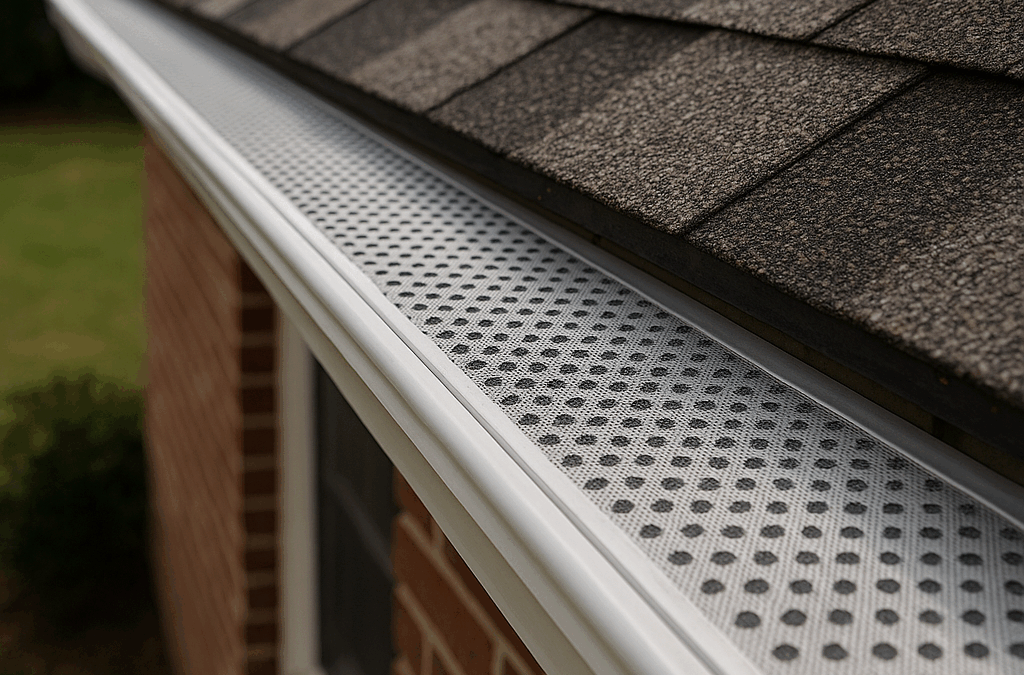
Louisville, Kentucky homeowners dealing with gutters that fill rapidly with leaves, twigs, seed pods, and debris from the region’s abundant tree coverage understand the frustration of constant gutter maintenance. The recurring cycle of cleaning, the risk of ladder accidents, and the consequences of missed cleanings resulting in water damage motivate many Louisville property owners to explore gutter guards as a potential solution. Cardinal Gutters recognizes that Louisville homeowners deserve comprehensive, honest information about gutter guards—what they are, how different types work, what genuine benefits they deliver, and what realistic limitations exist—before investing in these systems for their properties.
What Gutter Guards Are
Gutter guards encompass a wide variety of products designed to reduce or prevent debris from entering and accumulating in gutter channels while allowing rainwater to flow freely through drainage systems. Despite sharing this fundamental goal, gutter guard products differ enormously in construction materials, engineering principles, installation requirements, and actual performance outcomes. This significant variation across the marketplace makes understanding product categories essential for making informed decisions.
The term “gutter guard” serves as an umbrella description covering multiple distinct product types that work on entirely different principles. Some create physical filtration barriers. Others use water’s surface tension properties. Some fill gutter channels with porous material. These fundamental differences in operating principle translate to different performance characteristics, maintenance requirements, and suitability for specific conditions. A system that performs well in one environment may prove inadequate in another with different tree species, rainfall patterns, or debris characteristics.
Types of Gutter Guards: How Each Works
Micro-Mesh Systems represent the premium end of the gutter guard spectrum. These products stretch extremely fine mesh—often surgical-grade stainless steel with openings as small as 50-100 microns—over sturdy aluminum frames installed over gutter openings. Water passes through the tiny mesh openings while virtually all debris including fine pine needles, seed pods, and even shingle granules cannot penetrate. Quality micro-mesh systems feature angled designs encouraging debris to slide off the mesh surface rather than accumulate. These systems consistently receive the strongest performance reviews from independent testing but represent higher initial investments, typically requiring professional installation and costing $15-$30 or more per linear foot installed.
Standard Screen Guards use larger mesh openings than micro-mesh systems, blocking leaves and substantial debris while allowing water to pass. These systems vary substantially in construction quality from inexpensive stamped plastic or aluminum screens to more robust products with better-engineered openings and more durable frames. Standard screens work reasonably well blocking large debris but permit smaller material—pine needles, seed debris, small flowers, and shingle granules—to enter gutters. For properties with primarily large-leaf deciduous trees, standard screens can provide meaningful maintenance reduction at lower cost than micro-mesh systems.
Reverse Curve Guards operate on water adhesion principles. These products feature curved surfaces over which water flows, clinging to the curve through surface tension and entering the gutter through a narrow opening below the curve while debris theoretically continues past and falls to the ground. Reverse curve systems typically feature substantial construction and professional appearance, usually requiring professional installation for correct positioning. Performance depends significantly on installation angle, roof pitch, and rainfall intensity. Heavy rainfall rates, such as those Louisville commonly experiences during spring and summer thunderstorms, sometimes overwhelm the surface tension mechanism, causing water to overshoot gutters.
Foam Inserts fill the gutter channel with shaped porous foam, allowing water to permeate through the foam while debris rests on top. These products appeal through low cost and simple self-installation. However, their performance in Louisville’s environment reveals significant shortcomings. Louisville’s humid conditions and moderate temperatures promote seed germination in foam materials, with plant roots penetrating and destroying foam structure. Fine debris fills foam pores over time, restricting water flow. UV degradation gradually breaks down foam material requiring periodic replacement. Removal and cleaning of debris-laden foam often proves more difficult and messier than cleaning open gutters.
Brush Insert Systems place cylindrical brushes in gutter channels with the expectation that water flows through bristles while debris collects on top. Similar to foam inserts, brush systems provide initial performance but collect debris within bristles over time. Cleaning requires removing long brush sections, cleaning them, and reinstalling—a significant undertaking. These systems work better in some environments than others but generally provide less comprehensive protection than quality screen or micro-mesh alternatives.
Solid Cover Systems cover the gutter with a solid material featuring a narrow water-entry slot at the front. Water flows off the roof surface, clings to the solid cover through surface tension, and enters through the narrow slot while debris falls to the ground. Better-engineered versions of these systems handle typical rainfall well, but like reverse curve systems, very intense rainfall can overwhelm the surface tension mechanism. These systems typically offer good protection from large debris and pests.
Louisville’s Environment and Gutter Guard Performance
Louisville’s tree canopy creates specific debris management challenges affecting gutter guard performance. The city and surrounding region support extensive oak populations producing heavy leaf fall and acorns that challenge gutter systems. Maple trees throughout Louisville neighborhoods release substantial quantities of samaras—the winged seed pods—that can work their way through various guard types. Sweetgum trees produce distinctive spiky seed balls that lodge in some guard designs. Louisville’s various pine plantings produce needles requiring fine-mesh filtration. This diversity of debris types means that guards well-suited to one debris type may prove inadequate for another present on the same property.
Louisville’s humid subtropical climate means organic debris doesn’t simply dry and blow away after falling on guard surfaces. Moist debris decomposes into organic paste that gradually clogs mesh openings and creates biological activity on guard surfaces. The relatively mild winters rarely kill all biological activity, meaning seeds germinate and organic material decomposes year-round. These conditions require periodic cleaning attention for even the best-performing gutter guard systems.
Louisville’s rainfall patterns test gutter guard water-handling capacity. The city receives approximately 45 inches annually with rainfall distributed throughout the year, including spring thunderstorm seasons delivering intense high-volume precipitation. Systems with limited water-handling capacity may allow water to overshoot gutters during these intense events, negating their protective purpose.
Genuine Benefits Quality Guards Provide
Quality gutter guard systems provide real, meaningful benefits worth serious consideration. Significantly reduced cleaning frequency represents the primary practical advantage—homeowners who previously maintained gutters three to four times annually often find once-yearly cleaning sufficient with effective guards, translating to real time and cost savings over years of ownership.
Reduced emergency situations provide important value. Completely blocked gutters can cause sudden overflow events during storms, sending water over gutter edges directly against fascia boards and foundations. Quality guards that prevent complete blockages eliminate these sudden emergencies even if they don’t eliminate all maintenance requirements. This protection from acute damage events represents meaningful value beyond simple maintenance convenience.
Guards limit pest access and attraction. Open gutters collecting standing water and organic debris attract mosquito breeding, provide nesting material for birds, and create habitat for various insects. Guards significantly reduce these conditions, decreasing pest activity around homes.
Some guard designs reduce ice formation concerns during Louisville’s occasional winter freeze events. Guards preventing water-holding debris accumulation reduce conditions where ice forms and expands at gutter edges, though this benefit varies by specific product design and Louisville’s generally moderate winters limit this concern.
Realistic Limitations to Understand
Honest assessment requires acknowledging gutter guard limitations. No currently available system completely eliminates maintenance requirements under Louisville’s conditions. Fine debris, pollen, and decomposed organic material eventually requires attention on any system. Homeowners expecting to permanently eliminate gutter maintenance after guard installation will likely be disappointed regardless of system quality.
Marketing claims for gutter guard products frequently overstate performance and understate maintenance requirements. Independent testing and consumer reviews consistently reveal that real-world performance falls short of manufacturer marketing claims across most product categories. Healthy skepticism and thorough research beyond manufacturer materials helps set realistic expectations.
Cost-effectiveness requires honest property-specific analysis. Homes with minimal tree coverage near gutters may find the reduced cleaning frequency doesn’t justify premium guard system costs. Properties heavily surrounded by deciduous trees with diverse debris types may find quality micro-mesh systems provide excellent long-term value.
Conclusion
Gutter guards offer Louisville, Kentucky homeowners potentially meaningful maintenance reduction and protection benefits, but selecting appropriate systems requires honest understanding of product types, realistic performance expectations, and careful matching of system characteristics to specific property conditions. Cardinal Gutters believes that Louisville homeowners benefit from understanding the genuine differences between micro-mesh, screen, reverse curve, foam, brush, and solid cover systems, recognizing how Louisville’s specific tree canopy, humid climate, and rainfall patterns affect performance, and approaching purchasing decisions with realistic expectations rather than marketing-driven assumptions. When properly selected and installed for specific property conditions, quality gutter guards can provide lasting value reducing maintenance burdens and protecting homes from the water damage consequences that chronically clogged gutters cause.