
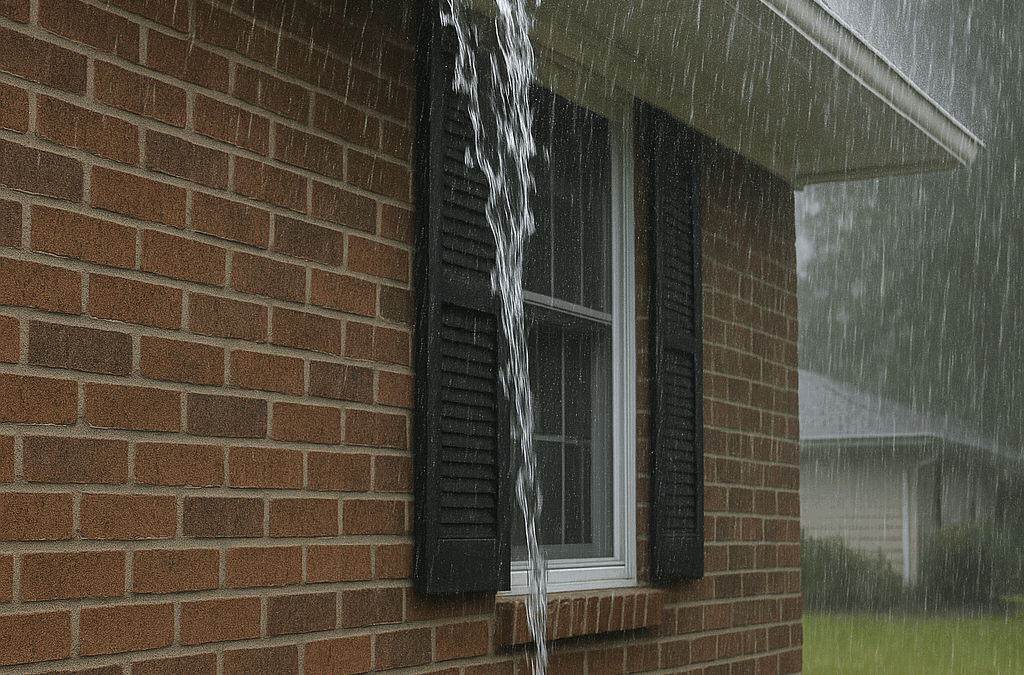
A puddle beneath a downspout is easy to notice and difficult to interpret from one glance. The water may be evidence that roof runoff reached the outlet, while its location and persistence may reflect conditions at ground level. During a different Louisville storm, the same spot can behave another way.
Understanding the sequence—from the roof edge to the drying soil—helps separate gutter flow from what happens after discharge.
The Outlet Receives More Than Direct Rainfall
A downspout delivers water collected across part of the roof. The ground below it therefore receives both direct rain and concentrated runoff. A small receiving area can temporarily take on water faster than it drains or absorbs.
This concentration means puddling is not automatic proof of a blocked gutter. If the outlet carries a steady stream while no water crosses the gutter edge, the roof runoff is reaching the bottom. The remaining question concerns its route after that point.
If the outlet produces little water while the gutter spills above, the order of events is different. Observing both locations at the same time provides important context.
Wet Ground Absorbs Water More Slowly
Soil usually has more capacity at the beginning of a rain than after prolonged wet weather. As pores fill, water may remain on the surface. An area that showed no puddle during a brief shower can collect water late in an all-day rain.
Compaction also matters. Foot traffic, construction, roots, and landscape equipment can change the ground below the outlet. Mulch, gravel, lawn, concrete, and bare soil each spread and absorb water differently.
Drying time adds another clue. A shallow pool that recedes soon after the storm follows a different pattern from standing water that remains into the following day. Weather conditions after the rain—sun, wind, humidity, and temperature—also affect that timing.
Small Grade Changes Shape the Pool
Water follows the immediate surface rather than the overall appearance of the yard. A depression only a few inches wide can hold discharge beside an otherwise sloped lawn. Raised edging, settled backfill, or a walkway can interrupt the route away from the outlet.
The puddle’s shape may show direction. A narrow tail leading from the pool can trace surface flow. Sediment lines or shifted mulch may mark where repeated discharge has traveled. These signs describe the ground path but do not, by themselves, identify a gutter defect.
Fall Debris Can Redirect Water
Leaves often gather where moving water slows. At the base of a downspout, a wet leaf mat can spread the stream sideways, cover an opening, or hold moisture against the ground. A twig or piece of bark can redirect the discharge enough to change the puddle’s shape.
Debris can also restrict the gutter or downspout above. Gutter and downspout cleaning addresses material within that route, but it does not change the surrounding grade or soil.
Look for a group of clues rather than one leaf pile. Overflow at the roofline, weak discharge, or water escaping at a connection may point upstream. Strong outlet flow followed by a surface pool focuses attention on what happens after the water reaches the ground.
Buried Drain Connections Are Not Visible From Above
Some downspouts end above the surface; others connect to an opening or pipe at ground level. The destination of a buried pipe cannot be determined from the gutter alone. It may be part of a separate drainage route with its own slope, outlet, and condition.
Water emerging around the connection is a different observation from an open downspout emptying onto a lawn. Do not dismantle the joint during wet weather or assume where the underground line goes. Identifying that layout is separate from watching gutter flow.
Observe a Louisville Rain Safely
Remain under cover where the gutter edge and lower outlet are visible. Note when discharge begins, whether it stays steady, and whether water appears over the front or behind the gutter. Then watch how the stream behaves when it reaches the surface.
Avoid standing near flowing water during lightning, stepping onto saturated slopes, or using a ladder. A short phone video from a stable position may show the timing more clearly than memory alone.
After the storm, photograph the wet area and check it again later. Compare the outline and drying time after several events. A consistent shape suggests a repeatable local path, while a changing shape may reflect wind, storm intensity, or moving debris.
Putting the Louisville Puddle in Context
Pooling below a downspout can involve roof-runoff concentration, soil saturation, surface grade, outlet debris, or a buried connection. These conditions are not mutually exclusive, and the visible pool is the final part of a longer route.
For Louisville homeowners, a useful assessment begins with order and timing: what happened at the roof edge, what came through the outlet, where the water traveled, and how long it remained. That record can distinguish what is observable from what still requires further identification.