
Cool Ohio Valley mornings can leave metal gutters covered with moisture even when no rain fell overnight. At other times, a damp spot below a corner or outlet appears only while the gutter carries runoff. Because both conditions involve visible water, homeowners may mistake condensation for leakage or overlook a rain-related pattern as ordinary dew.
The most helpful evidence comes from when the moisture appears, where it begins, and how it changes as the weather changes.
How Outdoor Condensation Develops
Air always contains some water vapor. The dew point is the temperature at which the air next to a surface can no longer hold all of that vapor in invisible form. If a gutter cools to that point, droplets may form on the metal.
Clear skies and light wind can allow exposed surfaces to cool overnight. Louisville’s fall air may remain humid while evening temperatures drop, creating conditions for dew by sunrise. The same process can dampen roofs, vehicles, grass, and railings.
Condensation comes from the surrounding air. It does not require water to be present inside the gutter.
Distribution Provides an Important Clue
Dew frequently appears across a wide section rather than at one fitting. Numerous small droplets may cover the gutter face, underside, and downspout. Nearby outdoor surfaces often show similar moisture.
The pattern can change after sunrise. Sections receiving direct light may dry first, while gutters shaded by trees or facing north remain wet. A homeowner inspecting later may see only the shaded moisture and assume it originated at that location.
Widespread beading on a rain-free morning is consistent with condensation, but context still matters. Irrigation, melting frost, and other local water sources can produce dampness unrelated to either dew or a gutter leak.
Rain-Dependent Drips Have a Different Pattern
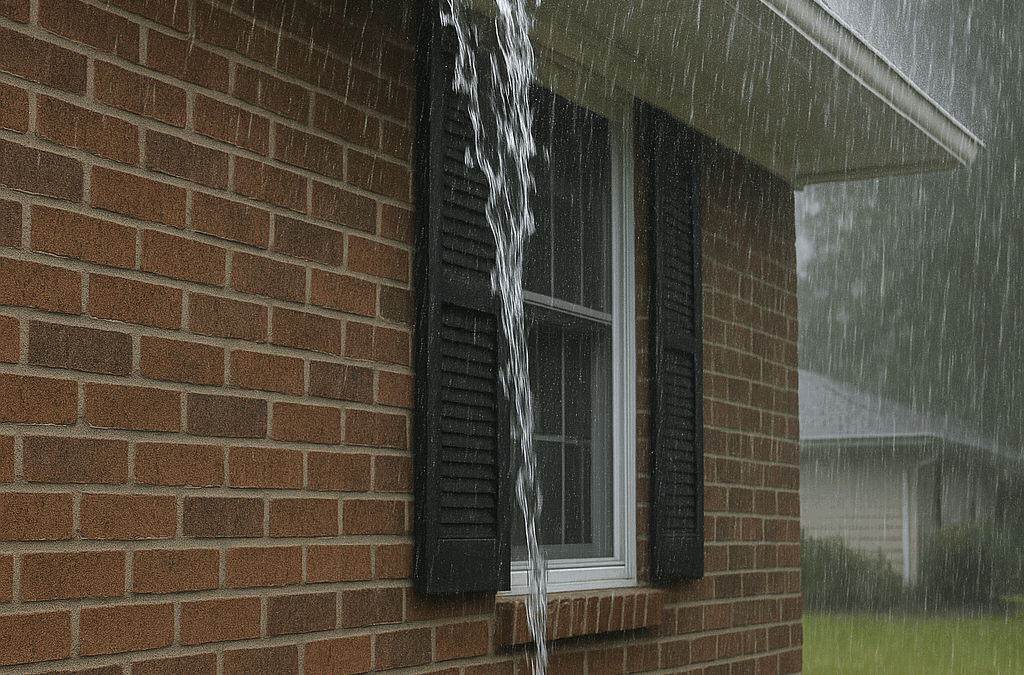
A gutter leak typically becomes active when runoff reaches the affected point. Water may escape at an end cap, corner, outlet, or downspout connection. The drip may start immediately in light rain or only after the water level rises during a heavier storm.
Moisture behind the gutter or on fascia and soffit should be distinguished from droplets on the exposed face. Water at the roof edge can follow several routes before it becomes visible, and the lowest visible drip point may not be the original source.
Repeated staining can mark an older path, but it cannot show whether water is moving there today. Observation during actual rain is more informative than a dry-weather stain alone.
Overflow May Drip From the Gutter Bottom
When water crosses the front lip, surface tension can carry it around the curved edge. It may release from the bottom and create the appearance of a hole or seam leak. Leaves, sediment, a restricted outlet, or concentrated roof runoff may contribute to the water level.
Louisville rainfall intensity varies, so a condition may be visible during a downpour but absent in a light shower. Wind direction can also push water onto surfaces that remain dry during calm rain.
Gutter and downspout cleaning relates to material inside the drainage route. It may change an overflow pattern when debris is involved, but it has no connection to atmospheric dew forming on exterior metal.
Dew and Leakage Are Not Mutually Exclusive
A gutter can develop condensation and also have a rain-dependent drip. On a day that begins damp and later turns rainy, the existing film may hide the point where new water begins moving.
Repeated comparisons help separate the sources. Check whether the same area is wet after a clear night, dry during a warm afternoon, and active again when rain arrives. A uniform film that fades with warming behaves differently from a concentrated drip synchronized with runoff.
A Ground-Level Observation Plan
Photograph the roofline early in the morning and again after temperatures rise. Include adjacent gutters and downspouts so the distribution is visible. Record whether grass, vehicles, and other metal objects also carry dew.
During rain, stay in a safe, sheltered position. Note when a drip begins and whether water first crosses the gutter front, appears behind the channel, or emerges at a joint. Observe the closest downspout discharge if it can be seen from the ground.
Do not use a wet ladder or place one against a gutter. Uneven ground, fallen leaves, and overhead utilities add risk. Zoomed photos can document small changes without direct roof access.
Moisture Makes More Sense With a Timeline
For Louisville homeowners, morning droplets alone do not establish a gutter problem. Condensation often covers broad cool surfaces and fades as they warm. Leakage is more likely to repeat at a particular point while rainwater is moving, while overflow follows the level and route of runoff.
A short timeline of weather, temperature, location, and drying behavior can make the distinction clearer. It keeps ordinary fall dew from being treated as proof of a leak while ensuring that rain-dependent moisture is evaluated in the conditions that produce it.