
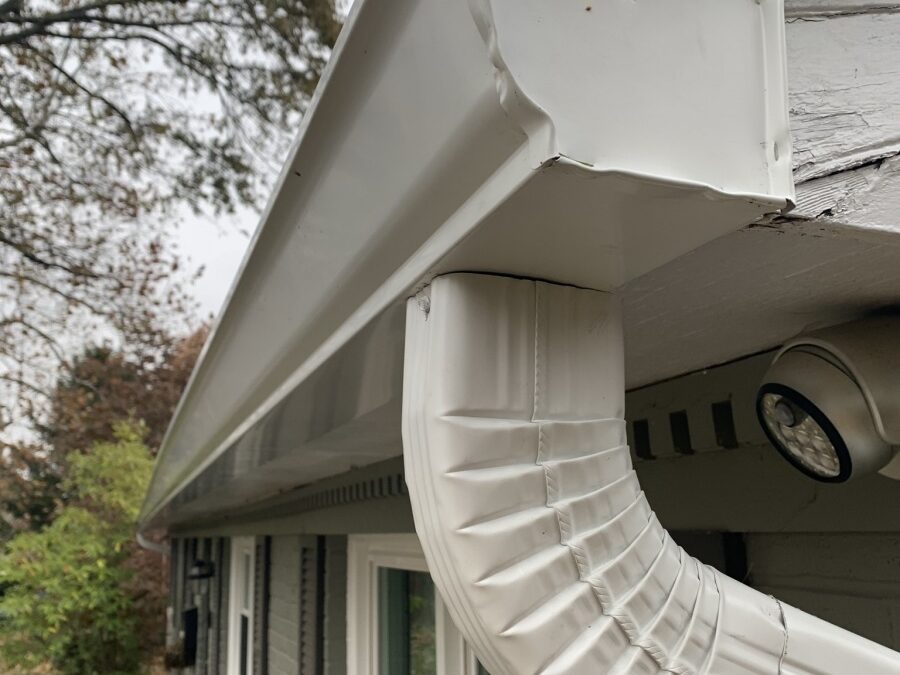
Stains on a gutter can reveal how water and weather have interacted with the roofline over time. Some Louisville gutters develop narrow black stripes. Others become dull and powdery, collect green patches in shaded areas, or show a broad dirty band after storms. These patterns are related, but they do not all have the same source.
Louisville’s humid summers, seasonal pollen, mature trees, and repeated wet-dry cycles give residue many opportunities to accumulate. Learning to read the pattern can help homeowners distinguish a cosmetic change from a clue about gutter flow.
The Source of Dark Vertical Lines
The upper front edge of a gutter is not always a sharp boundary for rainwater. A small amount of runoff can curve over that edge and descend the outside surface. Dust, pollen, roof particles, and organic residue travel with it. Evaporation leaves a thin deposit along the route.
When this happens repeatedly, the deposits become visible as vertical lines. The informal term “tiger stripes” is often used because several parallel marks can resemble stripes. They may appear on a gutter that is still moving water through its channel and downspouts.
The presence of stripes therefore does not establish that the system is clogged. It shows that water and residue have repeatedly crossed the gutter face. The surrounding evidence determines whether that movement is minor surface wetting or part of a larger overflow pattern.
Four Stain Patterns to Recognize
Dark Tracks From the Front Lip
Runoff tracks typically start at the gutter’s top edge and extend downward. They may be narrow, uneven, and darker where the surface stays damp. Sections below roof valleys can show heavier deposits because more water approaches those points.
Broad Fading or Chalking
Painted aluminum finishes weather with exposure. A light, dusty film spread across a large section is more consistent with chalking than with a single drainage path. Sun-facing and shaded elevations can age at different rates, so one side of a Louisville home may look noticeably duller.
Green, Brown, or Black Patches
Persistent shade and moisture can support algae, mildew, or other organic film. This is often patchy rather than linear. It may be more visible near trees, on north-facing eaves, or around areas that dry slowly.
Rust-Like Discoloration
An orange or reddish trail on an aluminum gutter may come from steel hardware or another nearby metal item. Its starting point matters. A mark beginning at a fastener is different from brown residue spread across the gutter face.
How Overflow Changes the Picture
Overflow often leaves more than a thin line. Water crossing the front edge can create a wide band, repeated drip marks, or splash patterns on surfaces below. Debris in the channel and restrictions at downspout openings are possible contributors. A steep roof plane or valley may also concentrate runoff at one portion of the system.
Louisville storms vary in intensity, so it helps to note whether the pattern occurs during light rain or only during a downpour. Water that moves normally in a gentle shower may behave differently when rainfall reaches the roof quickly.
Gutter and downspout cleaning addresses leaves, twigs, sediment, and other material inside the drainage route. That task is not the same as removing stains from the exterior coating. Even after interior debris is cleared, historic discoloration can remain on the gutter face.
Stains on Fascia or Soffit Need Separate Attention
A dark gutter face shows what happened on the outside of the channel. Marks on fascia, soffit, or the wall below may indicate that water followed another path. The transition between roofing and gutter includes components such as gutter apron and drip edge, which help guide water at the eave.
Discoloration behind a gutter might be associated with the roof edge, a localized drip, wind-driven rain, or water escaping at a corner or end. A static stain cannot confirm which explanation applies. Its location provides a starting point for observing the area when rain is actually present.
Safe Observation Comes Before Cleaning
Much can be learned from the ground. Photograph the roofline and zoom in to identify where each mark begins. Check whether staining aligns with a valley, end cap, downspout outlet, or shaded section. During rainfall, stay in a protected ground-level location and watch whether water crosses the front or appears behind the gutter.
If the issue seems cosmetic, remember that painted metal requires compatible care. Harsh solvents, strong acids or alkalis, and abrasive tools may affect the finish. Cleaning products should never be mixed, and any method permitted by the manufacturer should first be tried in an inconspicuous spot.
Ladder work creates fall and electrical hazards. A gutter is not designed to serve as a brace for a ladder, and wet autumn conditions can make footing less stable.
What the Stain Pattern Can Tell You
No single color offers a complete diagnosis. Parallel dark streaks often follow recurring runoff. Uniform dullness can reflect coating weathering. Patchy green or black areas tend to favor damp, shaded surfaces. Broad bands, splash marks, and nearby fascia stains may justify closer attention to water flow.
For Louisville homeowners, the key distinction is between a change in appearance and evidence that rain is leaving its intended route. Looking at the full roof edge—and observing it safely during wet weather—provides more information than trying to interpret a stain in isolation.