
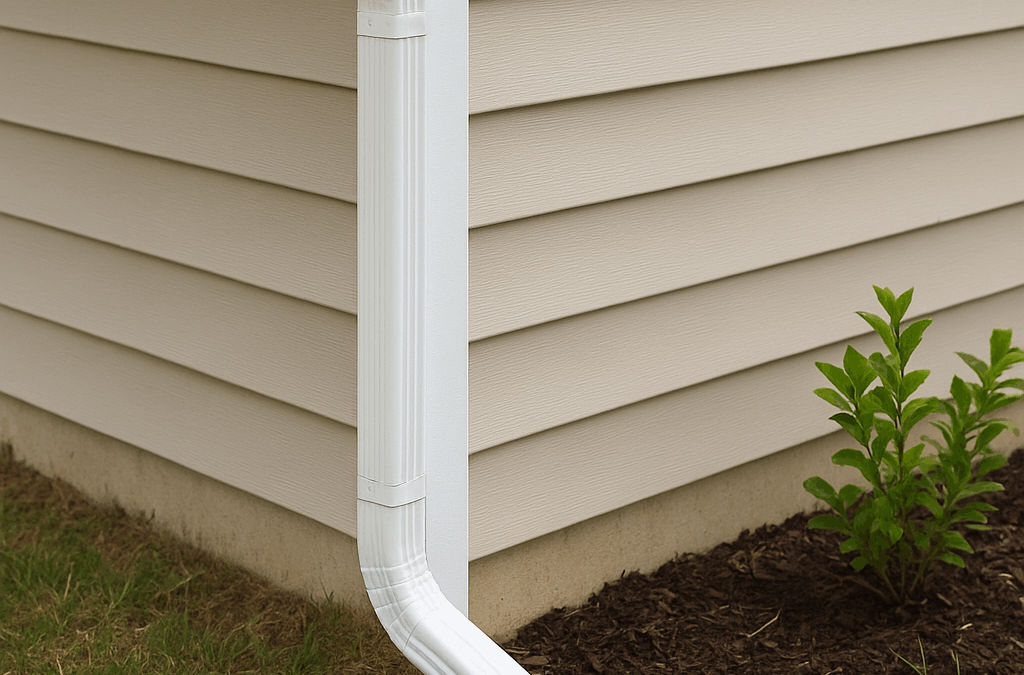
Louisville, Kentucky homeowners who maintain clean gutters, secure hangers, and properly sealed joints are addressing the roof-level components of their gutter system with appropriate care. But there is a ground-level component of that system that receives far less attention and that is equally critical to the gutter system’s core purpose: managing where water goes after it exits the downspout at grade level. In Louisville’s Ohio Valley climate — with its substantial spring rainfall, high summer humidity, clay-heavy soils, and active storm seasons — what happens at the base of each downspout determines whether the roof runoff collected by the gutter system is safely moved away from the foundation or deposited at the worst possible location adjacent to it. Cardinal Gutters believes that Louisville homeowners benefit from understanding downspout extensions, discharge management options, and the specific ground-level drainage considerations that Louisville’s geology, topography, and rainfall environment create.
Why Downspout Discharge Location Matters in Louisville
Louisville’s clay-dominated Ohio Valley soils are at the center of why downspout discharge management matters so much for Louisville homes specifically. Clay soils absorb water slowly, hold it tenaciously once saturated, and expand significantly when wet — contracting again as they dry. This shrink-swell behavior creates the lateral and vertical pressure on foundation walls and footings that cycles with soil moisture content, contributing over time to the foundation cracking, wall movement, and differential settlement that Louisville homeowners encounter more frequently than homeowners in regions with less expansive soils.
When downspouts discharge water directly at the foundation perimeter without extensions directing it away, they concentrate the entire rainfall collection of the roof surface — potentially hundreds of gallons per storm event — at the worst possible location. Louisville’s clay soils at the foundation perimeter absorb this water slowly, retaining it in direct contact with foundation walls and footings through the shrink-swell cycling that creates cumulative structural stress. Over a Louisville year receiving approximately 45 inches of annual rainfall, the cumulative volume of water deposited at the foundation perimeter by unextended downspouts in clay soil conditions creates the moisture cycling that represents genuine long-term foundation risk.
This is the fundamental reason why downspout extension and discharge management is not a secondary or cosmetic consideration for Louisville homes — it is a core foundation protection component as important to Louisville’s clay soil environment as any other aspect of the gutter system.
Extension Options for Louisville Homes
Rigid Aluminum or Vinyl Extensions: Standard rigid extensions attach to the downspout elbow at grade and carry discharge horizontally away from the foundation. Durable, simple, and effective when properly sized and positioned, rigid extensions are the most common discharge management solution for Louisville residential installations. Length is the critical variable — extensions should carry discharge far enough from the foundation that water released at the extension outlet does not drain back toward the foundation along the topographic grade of the site.
Flexible Corrugated Extensions: Flexible plastic corrugated extensions offer routing adaptability for complex site conditions — they can navigate around planted areas, along foundation edges to reach better discharge locations, or toward drainage swales that carry water across the property. Their limitation in Louisville’s active outdoor maintenance environment is displacement susceptibility — mowing, trimming, and foot traffic regularly reposition flexible extensions from their intended orientation, requiring periodic position checks and correction.
Hinged Flip-Up Extensions: Hinged extensions fold flat during dry conditions and self-deploy to discharge orientation during rainfall. In Louisville’s active outdoor living season, the reduced ground-level obstruction of flip-up extensions during dry periods makes them a practical choice for locations where fixed extensions would interfere with lawn maintenance or foot traffic patterns.
Underground Drainage Systems: Buried piping connected to downspout outlets carries discharge completely below grade to a remote discharge location. Underground systems are the most permanent and visually clean discharge management solution — eliminating all above-grade hardware while providing effective long-distance water routing away from the foundation. In Louisville’s established neighborhoods — the Highlands, Cherokee Triangle, Crescent Hill, Anchorage — where landscape aesthetics and property presentation are significant considerations, underground downspout drainage systems provide the most unobtrusive foundation moisture protection available. Underground systems require periodic maintenance to keep outlets clear and to address root intrusion or sediment accumulation that can develop over time in Louisville’s root-active soil environment.
Rain Barrel Systems: Rain barrels connected to downspouts capture initial storm discharge for landscape irrigation reuse. Their capacity — typically 50 to 100 gallons for standard residential barrels — fills rapidly during Louisville’s significant spring and summer storm events. Overflow routing from the barrel to an appropriate discharge location away from the foundation is essential for rain barrel systems to function as foundation protection components rather than simply capturing the first portion of storm discharge and then overflowing to grade adjacent to the foundation.
Splash Blocks: Necessary but Not Sufficient
Every downspout outlet should have at minimum a splash block — a sloped concrete or plastic form that receives downspout discharge and directs it away from the foundation at grade. Splash blocks protect against the concentrated impact erosion of unprotected discharge and provide a minimal degree of directional water management. However, standard splash blocks extend only 18 to 24 inches from the downspout outlet — inadequate in Louisville’s clay soil environment to create meaningful separation between concentrated discharge and the foundation perimeter.
Splash blocks are the appropriate minimum installation standard at a downspout discharge point but should be supplemented with extensions in most Louisville residential situations — particularly at downspouts serving large roof areas, on flat or inward-sloping lots, or in locations adjacent to basement window wells or below-grade foundation features where water concentration near the foundation carries elevated risk.
How Louisville’s Topography Affects Extension Requirements
Louisville’s residential landscape spans a significant range of topographic conditions that affect how downspout discharge management should be configured at individual homes.
River Corridor and Valley Floor Areas: Properties in Louisville’s river corridor neighborhoods and Ohio Valley floor areas tend toward flatter topography, where surface drainage moves slowly and soil drainage is often slower than on elevated terrain. On flat Louisville lots, downspout extensions must provide discharge separation by their length alone — natural topographic grade cannot be relied upon to carry discharged water away from the foundation after it exits the extension. Underground systems or longer extensions directing water toward street drainage or established drainage swales are often the most effective solutions on flat Louisville lots.
Hillside and Slope Properties: Louisville’s Eastern neighborhoods and the hillside areas of the metropolitan edge include properties with significant topographic slope. On sloped Louisville lots, the direction of slope relative to the downspout location determines extension requirements. Downspouts on the uphill face of a sloped property discharge to grade that naturally carries water away from the foundation; downspouts on the downhill face may discharge to grade where natural drainage patterns converge toward the foundation. Identifying slope direction at each downspout location is an important step in configuring effective discharge management for Louisville’s sloped residential sites.
Older Urban Neighborhoods: Louisville’s older established urban neighborhoods — many with mature landscape plantings, established foundation beds, and historic hardscape features adjacent to the home — create complex site conditions where standard extension orientations may be constrained by existing landscape and hardscape features. Underground systems or carefully routed flexible extensions that navigate around established landscape elements may be the most appropriate solutions in these complex site conditions.
Foundation Grading: The Essential Complement
Downspout extensions are most effective when they work in conjunction with properly graded soil adjacent to the foundation. Proper foundation grading — soil sloping consistently away from the foundation at a gradient sufficient to carry surface water away from the perimeter — ensures that water arriving near the foundation from any source, including downspout discharge, moves away rather than accumulating against foundation walls.
In Louisville’s established neighborhoods, foundation grading has often been altered by decades of soil settling, landscape modifications, tree root activity, and maintenance work that has cumulatively created flat or inward-sloping conditions adjacent to foundations that were originally graded correctly. Identifying and correcting negative or flat foundation grading in the areas between and around downspout discharge points is an important complement to extension management in Louisville’s residential environment.
The combination of properly extended downspouts discharging to appropriately graded soil creates the comprehensive surface drainage management that protects Louisville foundations from the moisture cycling that the city’s clay soils translate into structural stress.
Identifying and Correcting Common Deficiencies
Missing Extensions: The most common and most easily corrected deficiency — downspouts terminating without any extension hardware, discharging directly against the foundation. Extensions may be absent from original installation, removed during renovation or landscaping work, or lost to displacement and not replaced.
Incorrectly Directed Extensions: Extensions that discharge toward the foundation, into topographic depressions near the foundation, or against adjacent structures provide no foundation protection benefit and may actively concentrate discharge near the home. Regular position checks maintain the intended orientation.
Undersized Extension Length: Extensions that are technically installed but terminate too close to the foundation — particularly on flat lots or those with inward topographic slope — may not create the discharge separation necessary for effective foundation moisture management in Louisville’s clay soil environment.
Blocked or Failed Underground Systems: Underground systems that have developed blockages — from root intrusion, sediment accumulation, or outlet obstruction — may back water up through the downspout during heavy rainfall, causing gutter overflow at roof level from a ground-level blockage that may not be immediately identified as the source. Annual outlet inspection and flushing maintains underground system performance.
Practical Seasonal Maintenance
Louisville’s four-season climate creates a practical seasonal framework for downspout extension and discharge management maintenance:
Pre-spring storm season: A systematic check of all extension positions, outlet conditions, and foundation grading adjacent to discharge points confirms that the discharge management system is fully prepared for Louisville’s most active rainfall period.
After lawn maintenance sessions: Quick visual checks confirm that mowing and trimming equipment has not displaced extensions from proper orientation.
Post-storm assessments: Following significant Louisville thunderstorm events, checking extension positions and discharge point conditions confirms system integrity and identifies any storm-related displacement.
Autumn leaf fall: Underground system pop-up emitters and outlets can become blocked by leaf accumulation during Louisville’s significant autumn defoliation — clearing these outlets before winter ensures systems remain functional for off-season precipitation events.
Conclusion
Downspout extensions and proper ground-level water discharge management are essential components of a complete residential gutter system for Louisville, Kentucky homes — components that determine whether the roof runoff collected at the gutter level is safely moved away from the foundation or deposited at the location most likely to drive the foundation moisture cycling that Louisville’s clay Ohio Valley soils translate into structural stress. Without effective discharge management directing downspout water an appropriate distance from the foundation, the most carefully maintained gutter channels and downspouts cannot protect Louisville foundations from the concentrated moisture deposition that inadequately managed ground-level discharge creates. Cardinal Gutters recognizes that Louisville homeowners who understand and maintain proper downspout extension and discharge management — appropriate extension lengths, correct orientation, functional underground systems where installed, and proper foundation grading as the essential complement — are providing their homes with the complete, foundation-to-discharge-point water management that Louisville’s demanding clay soil and rainfall environment requires.