
Louisville homeowners increasingly encounter gutter guard recommendations as solutions to reduce maintenance burdens and improve drainage system reliability, yet substantial confusion persists about what different guard types actually accomplish, whether marketing claims of “maintenance-free” gutters reflect reality, and what meaningful performance differences exist between the numerous products available on the market. For properties in Louisville, KY, where abundant local tree coverage, significant annual precipitation, and freeze-thaw winter cycles create distinct environmental challenges for gutter systems, understanding gutter guard technology, various system designs, their legitimate capabilities and honest limitations, and realistic expectations about ongoing maintenance provides essential information for making informed decisions about guard investments. Cardinal Gutters of Louisville, KY presents this comprehensive educational resource explaining what gutter guards are, how different guard designs function, what benefits they can legitimately deliver, what challenges they present, and what homeowners should understand about actual guard performance in Louisville’s specific climate and environmental conditions.
What Gutter Guards Are and How They Function
Gutter guards, also called leaf guards, leaf filters, or gutter covers, are protective systems installed over or within gutter channels to prevent leaves, twigs, seeds, pine needles, and other debris from accumulating while allowing water to flow freely into the gutter system. The fundamental objective is reducing maintenance requirements by minimizing debris accumulation that would otherwise necessitate frequent cleaning. Well-designed guards aim to extend cleaning intervals, reduce overflow potential during heavy rain, minimize ice-related problems during winter, and protect gutter systems from damage caused by debris weight and organic decomposition.
The many different guard designs reflect various engineering approaches to the same central challenge: blocking debris while maintaining water flow capacity. Some systems use fine-mesh screens positioned inside gutters, others employ surface-tension technology relying on water’s physical properties to direct it into gutters while debris slides away, and still others use solid covers with small slots or perforations sized to exclude debris while permitting water passage. This diversity of designs acknowledges that no single approach perfectly achieves total debris exclusion while maintaining unrestricted water flow—all guards represent compromises between competing objectives.
Gutter guards represent an enormously broad product category spanning tiny differences in quality, cost, and actual effectiveness. The term encompasses everything from inexpensive temporary mesh screens homeowners install in minutes to sophisticated professional-grade engineered systems costing thousands of dollars for complete home installation. This enormous range means that the word “gutter guard” conveys virtually nothing about actual performance—some products deliver substantial real benefits while others provide minimal protection despite significant expense, and some actually create new problems while solving none.
Louisville Climate Characteristics Affecting Guard Performance
Louisville’s specific environmental conditions directly influence how gutter guard systems perform in real-world conditions. The city has abundant tree coverage with diverse species—oaks, maples, sycamores, tulip poplars, ash, hickories, and pines—that collectively generate substantial seasonal debris loads. Oak trees drop acorns and leaves heavily in fall with ongoing twig generation. Maples shed winged seeds in spring and leaves in fall. Pines shed needles continuously throughout the year. Hickories drop nuts and leaf fragments. Sycamores produce distinctive seed balls. This diverse, continuous, and sometimes intense debris generation challenges gutter guard systems more severely than regions with less tree coverage or simpler seasonal patterns.
Louisville’s humidity combined with warm summer temperatures creates excellent conditions for biological colonization of gutter systems. Mold, algae, mildew, and fungal organisms readily establish on moist surfaces, and many gutter guard designs—particularly fine-mesh screens—tend to trap moisture and organic material that actively promotes biological growth. When organic debris accumulates on guard surfaces or against mesh openings, fungal and bacterial colonization accelerates, progressively clogging guards and creating visible staining and discoloration. This biological challenge is more pronounced in Louisville’s humid climate than in drier regions.
Louisville receives approximately forty-five inches of annual precipitation distributed throughout the year, with substantial rainfall during spring and summer thunderstorm seasons. Individual storms can deliver multiple inches in short periods, creating peak water volumes that may exceed the intake capacity of many guard designs. When guards cannot accept water quickly enough, water backs up behind them and overflows, potentially causing the very problems—foundation saturation, landscape erosion, basement moisture—that guards are intended to prevent. Evaluating how different guard types perform during realistic high-rainfall conditions is essential for Louisville properties.
Winter conditions, while less severe than northern regions, create challenges for guard systems. Freeze-thaw cycling causes water infiltrating guard seams to freeze and expand, potentially damaging attachment points or warping guards. Additionally, when guards become iced over, they prevent water drainage during thaw periods, creating backup that can force water behind gutters or infiltrate interiors during the warming portion of the freeze-thaw cycle.
Louisville’s clay-heavy soils drain slowly, meaning that any overflow from gutters due to guard-related flow restriction can cause foundation saturation and basement moisture problems. This soil characteristic makes guard performance during heavy rainfall particularly important for foundation protection.
Different Gutter Guard Type Systems
Understanding how various guard designs attempt to solve the debris-exclusion problem helps evaluate realistic performance expectations.
Mesh and Screen Guard Systems
Mesh and screen guards use fine or coarse woven material installed inside gutters or across gutter openings to filter debris while allowing water passage. Mesh sizes vary considerably—from open screens blocking only large branches to fine micro-mesh intended to exclude pollen and roofing grit. These guards attract homeowners through low initial cost, wide availability, and relative ease of do-it-yourself installation without specialized tools or expertise.
Practical limitations significantly impact effectiveness. Fine mesh clogs with accumulated organic material, pollen, shingle grit, and seed particles over time, progressively reducing water flow capacity and effectiveness. In Louisville’s humid climate, organic material accumulating on mesh actively promotes mold, algae, and fungal growth that further restricts water flow and creates unsightly discoloration. Coarser mesh that resists clogging allows substantial fine debris through, requiring nearly as frequent cleaning as systems without guards. Most mesh systems require periodic cleaning of the guards themselves—sometimes multiple times seasonally—which reduces the maintenance-elimination benefit they promise. Wet leaves and decomposing organic matter mat against mesh surfaces, becoming difficult to remove without complete guard disassembly.
Surface-Tension Reverse-Curve Guard Systems
Surface-tension or reverse-curve guards use a curved hood design allowing water to follow the curve and drop into gutters below, while debris slides off the outer edge. This design relies on water’s cohesive properties—its tendency to cling to surfaces and curve downward—while larger debris particles cannot follow the curve and slide away. Theoretically, this allows optimum water entry while excluding most leaves and twigs.
Advantages include minimal openings where debris can enter and natural shedding of larger leaves and branches. However, significant limitations exist. During intense rainfall when water volume is high, the curved surface cannot accept water quickly enough, causing backup and overflow despite adequate gutter capacity below. In Louisville’s thunderstorm season, this capacity limitation presents real performance concerns. Wet leaves can stick to curved surfaces, fine seeds and needles still accumulate in gutters below requiring cleaning, and regular maintenance is still necessary though often less frequent than without guards. Ice formation during winter can also occur behind the guard when water backs up during thaw cycles.
Foam Insert Guard Systems
Foam inserts consist of porous foam material cut to fit gutter dimensions. Water passes through foam while debris theoretically stops at the surface and can be swept or rinsed away. This design offers simplicity and low cost.
Practical limitations significantly reduce effectiveness. Wet decomposing leaves mat against foam and resist easy removal, often requiring disassembly and vigorous scrubbing. Foam itself degrades from UV exposure, biological colonization, and physical deterioration, typically requiring replacement every five to ten years. In Louisville’s humid climate, degradation occurs faster as mold and bacterial growth weaken material. Water flow through foam can be slower than optimal, potentially contributing to overflow during heavy rainfall despite adequate gutter capacity below foam. Additionally, foam becomes a debris collection point itself, essentially moving the maintenance problem from gutters to guard surfaces.
Perforated or Slotted Solid Cover Systems
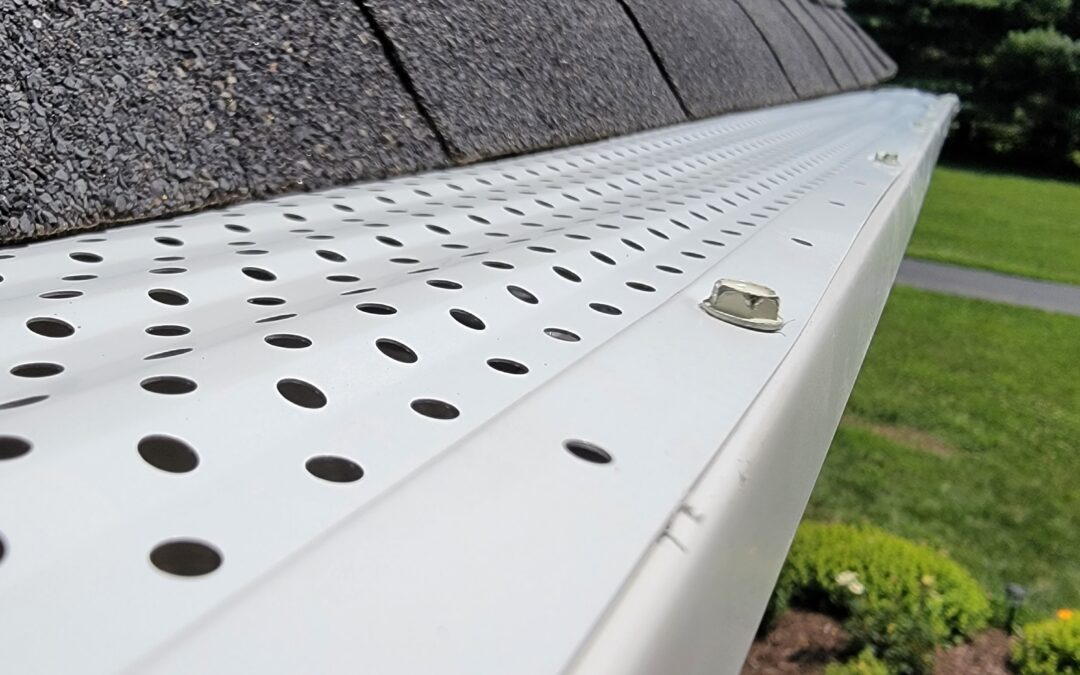
Some guards use solid metal or plastic covers with small perforations or slots intended to be small enough to exclude debris but large enough to pass water. This approach attempts to avoid fine-mesh clogging while maintaining water flow.
The fundamental engineering challenge is that slots small enough to meaningfully exclude fine debris reduce water flow capacity, while slots large enough to maintain full flow permit significant fine debris passage. Real-world performance typically falls between ideal and disappointing—moderate debris exclusion with acceptable but reduced water flow. Slots can also become clogged with decomposing organic material and pollen, progressively reducing effectiveness. Some designs create turbulence increasing overflow potential during heavy rainfall.
Professional Engineered Guard Systems
High-end professional systems typically combine quality materials, engineered designs, and precise installation. These often integrate multiple technologies—perhaps fine stainless steel mesh backed by surface-tension design, or proprietary geometries developed through extensive testing. Professional systems cost considerably more but typically deliver better performance and durability than budget alternatives.
Premium systems justify investment for properties with significant tree coverage, those planning long-term residence, or those unable to afford or perform frequent cleaning. The higher initial cost becomes justified when reduced cleaning frequency and improved performance over fifteen to twenty-five years are calculated into total ownership cost.
Realistic Benefits and Honest Limitations
Understanding both what guards accomplish and what they cannot is essential for reasonable expectations.
Legitimate Benefits When Appropriate Guards Are Properly Installed
Homes with moderate tree coverage may reduce cleaning from quarterly to annually or semi-annually. Guards effectively keep larger leaves and branches out of gutters, reducing weight stress on mounting systems. They can help reduce ice dam potential by maintaining water flow during winter cycling. They may extend gutter service life by keeping systems cleaner. They reduce gutter attractiveness to pests and wildlife seeking nesting material.
Candid Limitations and Challenges
No guard completely eliminates all debris—fine material including pollen, seeds, grit, and decomposition products still accumulate. Most require periodic guard maintenance themselves. Guards typically underperform during intense rainfall. Performance depends heavily on proper installation. For many properties, guard costs may not justify savings from reduced cleaning, particularly if replacement is needed every ten to fifteen years. In Louisville’s humid climate with abundant trees, guards reduce but rarely eliminate cleaning needs.
Evaluating Guards for Your Louisville Property
Several factors should guide decisions about installation.
Tree Coverage Assessment
Minimal nearby tree coverage suggests limited guard benefit. Moderate coverage may justify guards. Extreme tree coverage may see limited benefit despite installation because some debris accumulation is inevitable.
Debris Type Evaluation
Different trees produce different debris. Large-leaf deciduous trees are more manageable with guards than needle-shedding pines or seed-producing maples. Research what your specific trees produce and how well different guard types manage that debris.
Realistic Maintenance Expectations
Consider whether you’ll perform periodic guard cleaning or whether that maintenance cost should be factored into the decision. Some guards require more guard maintenance than original gutter cleaning.
Total Cost of Ownership
Calculate complete costs including installation, replacement timing, and realistic maintenance against professional cleaning service costs. For some properties, regular professional cleaning may provide better value.
Integration with Overall Gutter Plans
Guards make most sense as part of comprehensive gutter system decisions. Installing guards on gutters nearing replacement may not make financial sense.
Conclusion
Gutter guards represent products with significant performance variation, broad cost range, and highly situation-dependent effectiveness, with actual benefits depending heavily on specific property characteristics, selected guard type, local tree coverage, climate factors, and realistic maintenance expectations. Cardinal Gutters of Louisville, KY encourages homeowners to understand that gutter guards reduce but don’t eliminate cleaning needs, perform differently based on Louisville’s specific environmental conditions and tree coverage, and may or may not provide sufficient benefit to justify their cost depending on individual circumstances. Thoughtful evaluation of property-specific factors, honest assessment of ongoing maintenance that guards require, and realistic expectations about actual performance helps ensure any guard investment delivers meaningful value. This educational overview is provided to inform homeowner decision-making without suggesting that guards are universally necessary, universally appropriate for all properties, or that any specific product delivers all promised performance.