
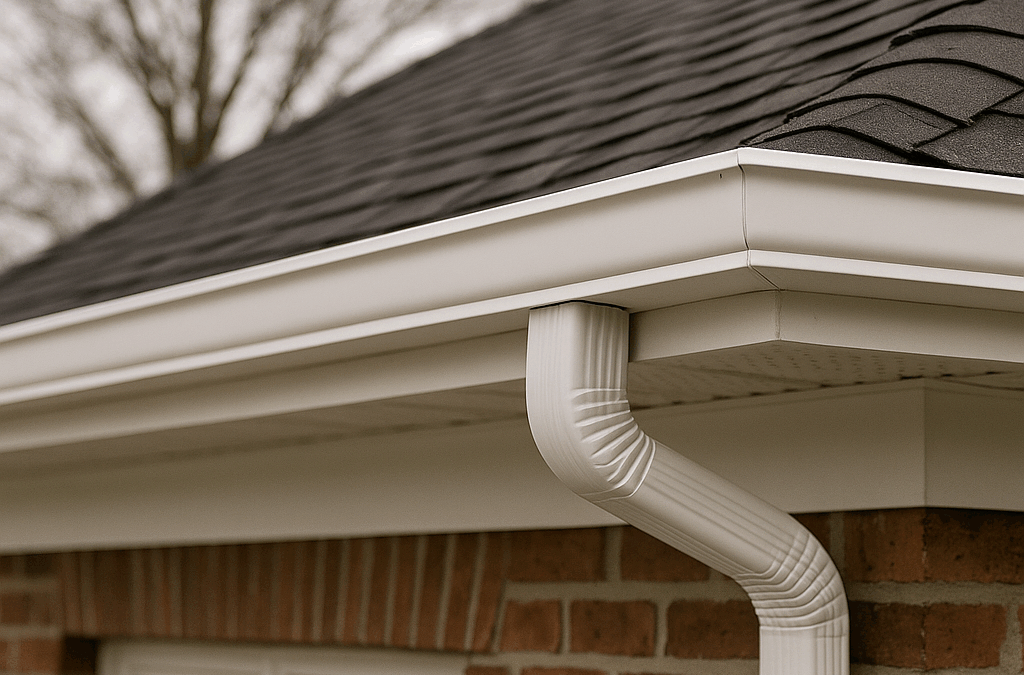
A steady stream from one downspout and barely a drip from another can seem like an obvious blockage. On a Louisville home, however, unequal flow may begin with the roof layout rather than the pipe. Each outlet receives water from a specific combination of roof surfaces and gutter sections, and those areas are rarely identical.
The difference becomes easier to interpret when the entire route—from roof plane to ground-level discharge—is considered in sequence.
Map the Roof Area Connected to Each Outlet
Imagine dividing the roof according to where runoff travels. A simple slope may drain to one straight gutter, while a valley can combine water from two adjoining surfaces. Porches, additions, dormers, and multiple roof levels create smaller drainage areas with their own outlets.
A downspout serving a valley and a broad roof plane may begin flowing early in a storm. A second pipe connected to a short eave may remain quiet until rainfall becomes heavier. Equal pipe dimensions do not mean equal collection areas.
The nearest outlet is not always the destination. Gutter slope may carry water lengthwise before it enters a downspout farther away.
Rainfall Does Not Reach Every Roof Surface Equally
Wind changes the angle of rain. One side of a Louisville home can receive direct, wind-driven rainfall while another side is partly sheltered. Taller roof sections and overhangs may further alter where water lands.
This effect can make one downspout appear inactive during a particular storm. If the pattern changes when the wind direction changes, unequal roof exposure may be part of the explanation.
Light rain also exaggerates small differences. A limited roof area may collect water without producing a clearly visible stream at the bottom of the pipe.
Outlet Placement and Gutter Pitch Shape the Flow
Gutters use a slight pitch to move water toward their outlets. A long run may slope to one end, or a high point may send water in two directions toward separate downspouts.
The divided sections do not have to be the same length. A valley or upper-roof discharge can also add water to one side of the high point. As a result, one outlet may consistently carry more runoff under normal conditions.
If the gutter develops a low section, water may pause or travel differently. Repeated standing water, a damp debris line, or overflow away from an outlet can provide clues, but each symptom has more than one possible cause.
Late-Fall Debris Can Create a Partial Detour
By late November, Louisville gutters may contain compacted leaves, seed material, twigs, and fine residue. A partial restriction can alter flow without producing a complete blockage.
Debris around an outlet may slow entry into one downspout. Water can then rise and move toward another outlet, spill over the edge, or remain in the gutter. Material inside an elbow can also reduce discharge at ground level while water continues entering from above.
Gutter and downspout cleaning addresses ordinary debris in the drainage path. Uneven flow can still remain when the underlying difference comes from roof area, gutter pitch, or outlet arrangement.
Compare Symptoms During Different Rainfall Rates
During a Light Shower
A small drainage zone may produce only intermittent drops. Lack of a strong stream is not enough to identify a restriction.
During Steady Rain
Both outlets may become active, but at different volumes. Note whether the connected gutter contains the water or shows localized overflow.
During a Fast Downpour
Concentrated runoff from a valley can reach one gutter section quickly. If another outlet remains quiet while water spills nearby, record the location and timing rather than assuming the pipe alone is responsible.
After Rain Stops
One pipe may drip longer because water remains inside an elbow, on corrugated surfaces, or in a shallow low area. The duration of the final drips does not measure the total flow during the storm.
Observe the Roofline and the Outlet as One System
From a safe position, identify where the roof appears to feed each gutter. Watch for runoff crossing over the gutter edge, traveling behind it, or concentrating below a valley. Then compare when each downspout begins releasing water.
An extension can move the visible discharge away from the house. Some pipes connect to an opening at ground level, making the final destination impossible to evaluate from the downspout alone. Surface water around that connection concerns a different section of the route.
Avoid climbing during rain, frost, or wet-leaf conditions. Do not lean equipment against the gutter or place hands into an unseen outlet. A zoomed recording from stable ground can capture the sequence for later comparison.
Repetition Makes the Observation More Meaningful
One storm provides limited evidence. Keep track of wind direction, rainfall intensity, overflow, and the order in which outlets start and stop. A downspout that is quiet during one light shower may behave differently during sustained rain.
When the same outlet repeatedly stays dry while its gutter fills, the pattern is more informative. When the active outlet changes with the weather, roof exposure may be playing a larger role.
Unequal Downspout Flow Has Several Possible Explanations
Louisville homes often have roof sections of different sizes and shapes. Gutter pitch, valleys, outlet positions, wind, and late-fall debris further influence the visible streams.
A useful assessment does not require both downspouts to match. It asks whether each connected roof and gutter section moves water along its intended path without recurring backup or overflow.