
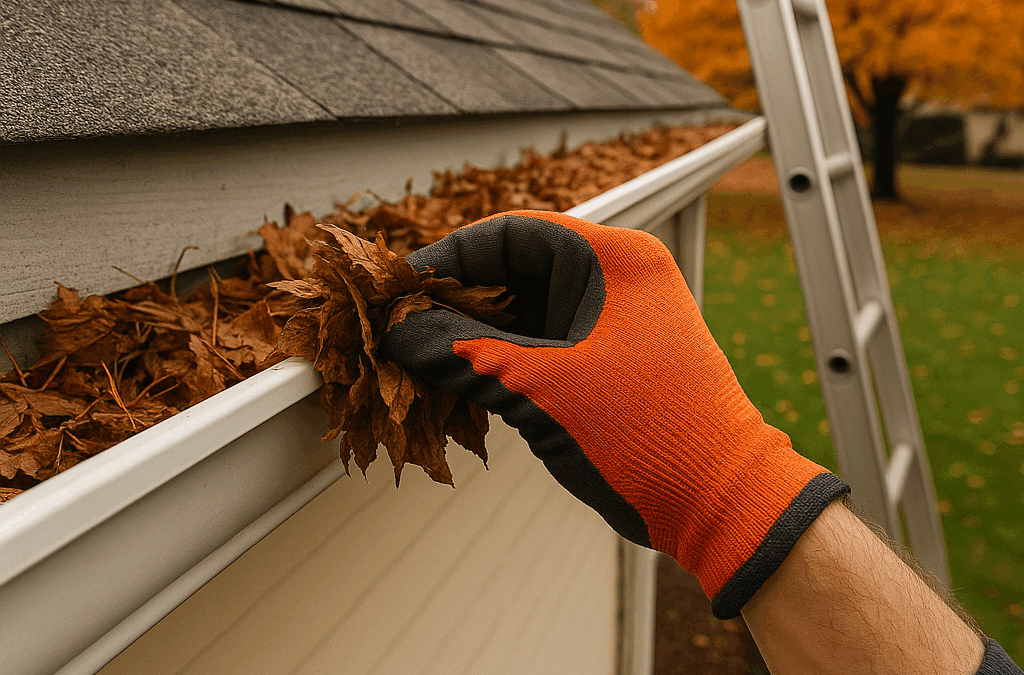
Louisville’s tree canopy sends many kinds of material toward residential rooflines in autumn. Broad leaves, acorns, seed pods, pine needles, twigs, and fine fragments do not interact with gutter guards in the same way. Some remain on top, some move away with wind, and some reach the gutter channel.
A guarded system therefore still changes throughout leaf season. The important distinction is that debris is being filtered and redirected, not removed from the roof environment altogether.
What a Gutter Guard Actually Changes
Without a guard, material reaching the eave can fall directly into the gutter. A guard places a surface between the roof and channel. Depending on its design, water enters through mesh, holes, slots, or another opening while at least some debris stays above.
Size is only part of the process. A long pine needle may bridge several openings. A curled leaf may initially leave space for water, then flatten when wet. Fine particles can move through openings that stop larger objects. Twigs can catch other debris and create a cluster much larger than the original obstruction.
The result is not simply “inside” or “outside.” Material can occupy the guard surface, the edge where roof and guard meet, the gutter below, or the downspout outlet.
Why Leaf Layers Form on Some Sections
Louisville fall weather includes dry breezes, damp mornings, and rainy periods. Dry leaves may travel across a smooth surface and leave the roof. Wet leaves become heavier and can cling to one another.
Roof shape also directs the pattern. Valleys deliver runoff and debris toward a narrow area. Inside corners can shelter material from wind. A low roof beneath taller trees may receive new leaves shortly after an earlier layer has shifted.
When several wet leaves overlap, they may form a mat across part of the guard. Fine sediment can occupy gaps within that layer. Drying may loosen it, but some mats remain until wind, additional rain, or maintenance changes their position.
Rainfall Reveals More Than a Dry Inspection
A dry layer of leaves shows where debris stopped, but it does not show exactly how water will behave. During rain, runoff may pass through available openings, move sideways toward a clearer section, or travel across the front edge.
Ohio Valley storms also differ in intensity. A guard may accept water during a light shower while a concentrated flow below a roof valley behaves differently in heavy rain. Water crossing the edge does not, by itself, identify whether the cause is debris, storm rate, guard position, or a combination of factors.
Observe the length of the roofline rather than only the most obvious pile. A normal-looking section beside a wet debris mat can provide a useful comparison. The timing of overflow—at the beginning of rain, only during the heaviest period, or after prolonged rainfall—adds context.
Small Debris Can Settle Inside the Gutter
Gutter guards can block many larger pieces while allowing smaller matter to follow water into the channel. Pollen, roof grit, tiny leaf fragments, and decayed organic material may form a thin layer below the guard. Sediment can be distributed along the run or concentrated near an outlet.
This is why the visible top surface does not tell the entire story. Leaves on top are not proof of an internal clog, and a clean top is not proof that the channel and downspout are clear.
Gutter and downspout cleaning concerns debris inside that water path. Surface leaf removal is related but not identical. Guard designs use different attachment methods, and bending or lifting a section without knowing how it is secured may change its fit.
How to Monitor a Guarded System Safely
Use ground-level photographs to record the same roof sections over several weeks. Pay particular attention below valleys, near roof intersections, and at locations where tree branches overhang the eave. Compare images taken after dry weather with those taken after rain.
During a storm, remain under cover and look for sheets of water crossing the front, isolated drip points, or sections that drain differently from their neighbors. Downspout discharge can also indicate whether water is reaching the outlet, although visible flow does not confirm that every section is unrestricted.
Avoid wet-roof access and never brace a ladder against a gutter. Before applying any tool or cleaner, consult information for the particular guard material. Abrasive methods may affect coated surfaces, and attached panels should not be treated as walking or hand supports.
Fall Attention Still Matters With Gutter Guards
Gutter guards may reduce the amount of large debris entering a channel, but they remain part of an exposed roof-edge system. Leaves can cover the surface, smaller matter can pass below, and runoff can concentrate where the roof directs it.
For Louisville homeowners, periodic observation throughout leaf drop provides a clearer picture than a single end-of-season glance. The way debris shifts between dry weather and Ohio Valley rain can show how a particular roof and guard design are functioning together without assuming that every visible leaf represents the same condition.