
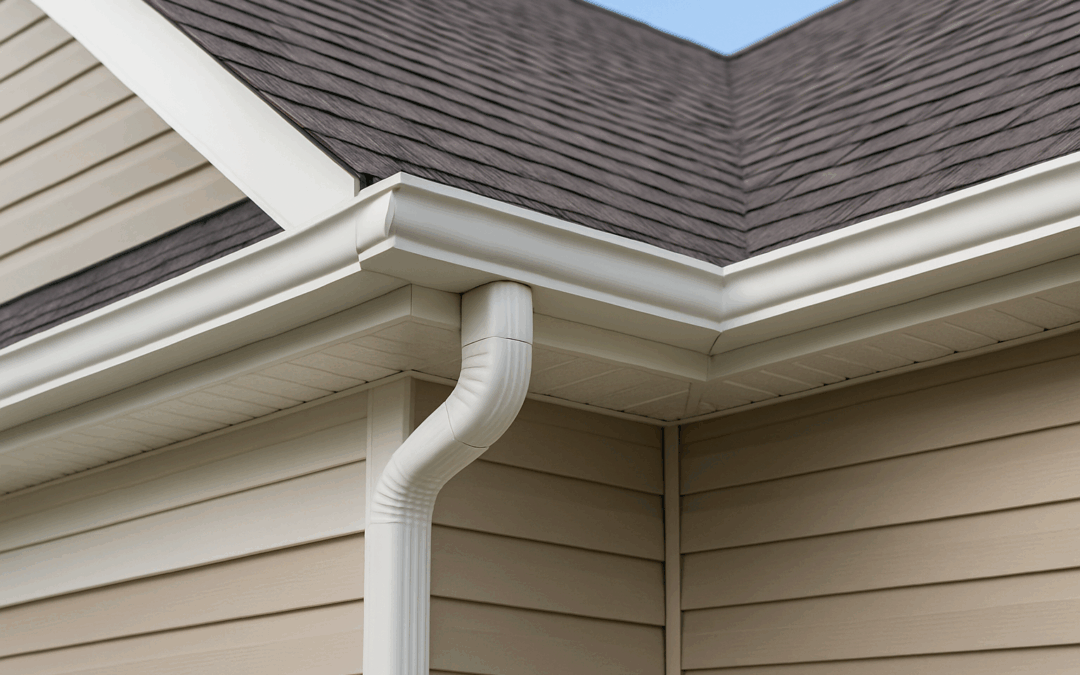
A gutter receives water from the roof above it, but that water does not arrive evenly along every eave. Roof pitch affects the route and speed of runoff, while valleys, dormers, porches, and intersecting planes determine where the flow is concentrated.
These relationships are useful for Louisville homeowners to understand. They can explain why overflow occurs in one location during an Ohio Valley storm even when another section remains well below its rim.
Understanding Roof Pitch
Roof pitch is the angle of a roof plane, commonly described by how much it rises over a horizontal distance. A steep roof has a sharper incline; a low-slope roof has a shallower one.
Pitch influences how directly gravity moves water toward the eave. It does not determine drainage by itself. Rainfall intensity, wind, roof material, surface condition, and drainage area all contribute.
The gutter must handle both the amount of water collected by the roof and the rate at which that water reaches a particular section.
Faster Runoff From Steep Roof Planes
On a steep surface, rainwater may reach the lower edge quickly after the roofing becomes wet. During a heavy storm, the flow can approach the gutter as a fast-moving sheet or several concentrated streams.
The channel’s position relative to the roof edge becomes important. Water may cross the front edge if its path and momentum carry it beyond the gutter opening. This is sometimes called overshooting.
Overshooting has more than one possible cause. Wind, gutter placement, roof-edge details, and accumulated material can all affect the path, so roof pitch should be treated as part of the explanation rather than a complete diagnosis.
Low-Slope Areas Have Their Own Drainage Pattern
Water may cross a shallow roof more gradually, but a wide low-slope section can still collect considerable rainfall. Porches, additions, and certain modern roof forms often create these broad surfaces.
Small surface changes can direct runoff into separate paths. Leaves, seams, transitions, and depressions may concentrate water before it reaches the eave.
A low roof is not necessarily safe to walk on. Wet material can be slippery, and edge conditions are difficult to evaluate securely during a storm.
Valleys Focus Water at One Point
Where two roof planes meet, the resulting valley acts as a collection route. Rain falling across both planes converges and reaches a limited area along the roof edge.
The gutter below that point handles a higher inflow rate than adjacent sections. It may spill during an intense Louisville downpour while the rest of the run appears normal.
Organic debris often follows the same route. Leaves, seed pods, and twigs can settle at the valley outlet, reducing the opening where water is already most concentrated.
Complex Rooflines Create Uneven Demands
Louisville includes historic houses, compact urban homes, split-level designs, and newer construction with multiple gables. Each roof arrangement creates its own drainage map.
A dormer can divide runoff into separate streams. An upper roof may drain onto a lower plane, adding water to the rainfall already landing there. An L-shaped addition may form an inside corner where two gutter runs meet.
The length of a gutter section does not reveal its entire workload. Homeowners also need to consider how many roof surfaces feed it and where those surfaces direct their water.
Roofing Surface Affects Movement
Smooth metal and textured shingles do not move thin layers of water in exactly the same way. Roof age, surface residue, and wind may also separate runoff into rivulets or sheets.
At the lower edge, drip edge or gutter apron influences how water leaves the roof boundary. These metal components are distinct from the roof’s pitch and from the gutter’s own slope.
Because several variables interact, identical roof angles can still produce different gutter observations.
Roof Pitch Is Not Gutter Pitch
The two terms sound similar but refer to separate directions of travel.
Roof pitch carries runoff downward toward the eave. Gutter pitch is the slight lengthwise slope that guides water toward a downspout. A roof can deliver water quickly while the gutter moves it slowly because of debris, a low point, or an outlet restriction.
This distinction helps explain why overflow can appear below a valley even when the gutter channel itself looks appropriately sized.
Freeze-Thaw Conditions Add a Seasonal Variable
As Louisville moves from fall into winter, water remaining in low sections can encounter repeated temperature changes. Roof pitch may move the initial runoff effectively, but the gutter and downspout still need to complete the route.
Debris below a valley can hold moisture at a high-flow location. The presence of retained water does not mean freezing damage will occur, but it is a relevant observation as overnight temperatures fall.
What to Watch From the Ground
During rain, Louisville homeowners can safely note:
- Whether overflow begins only during a downpour
- Whether it occurs below a roof valley
- Whether an upper roof contributes water to the same point
- Whether runoff crosses the gutter’s front edge
- Whether water travels behind the channel
- Whether the closest downspout discharges evenly
- Whether debris is visible at the concentrated entry area
There is no need to climb during wet conditions. A ground-level video can record rainfall intensity and the sequence of water movement.
One Storm Does Not Tell the Whole Story
Light rain, steady rain, and short intense bursts place different demands on a drainage route. Wind can shift the path, and seasonal debris can move between events.
If the same location repeatedly overflows at a similar rainfall intensity, the pattern provides more useful information than a single event. Comparing several storms can show whether the behavior depends on flow rate.
Reading the Roof and Gutter as One System
Roof pitch influences runoff speed. Valleys and intersecting planes direct that runoff toward selected sections. Surface material and edge details determine how it leaves the roof, while gutter pitch and downspouts control the remaining journey.
For Louisville homeowners, understanding that sequence makes localized overflow easier to interpret. A visible spill is not always a system-wide failure; it may reveal where roof geometry concentrates the greatest drainage demand.