In Louisville, Kentucky, fall is not simply a beautiful season — it is one of the most consequential periods on the home maintenance calendar. The Ohio Valley’s extraordinary hardwood canopy releases its leaves across October, November, and into December, loading gutter channels with the year’s heaviest debris volumes at the same time that the approach of winter makes properly functioning gutters most important for protecting the home. Louisville’s winters bring the Ohio Valley’s characteristic combination of sustained rainfall events, meaningful freeze-thaw cycling, and the ice storms that occur with sufficient frequency to make winter gutter loading a genuine structural concern. Gutters that enter Louisville’s winter season loaded with debris, with failed joints, with loose hangers, or without adequate downspout discharge management are not simply underperforming — they are actively contributing to fascia deterioration, foundation moisture damage, and roof edge structural stress during the months when repairs are most difficult and weather conditions are most demanding. Cardinal Gutters believes that Louisville homeowners who approach fall preparation as a structured, comprehensive process are protecting their homes far more effectively than those who treat fall maintenance as a single-event cleaning.
Understanding Louisville’s Fall Gutter Challenge
Louisville’s gutter maintenance challenge in fall is shaped by two factors that work in combination to create the year’s most demanding maintenance period: the Ohio Valley’s exceptional hardwood canopy debris loading and the character of Louisville’s winter weather.
The Louisville metropolitan area’s tree canopy — one of the Ohio Valley’s most remarkable urban forests, with mature oaks, sycamores, maples, beeches, walnuts, sweetgums, and diverse ornamentals lining the streets and yards of established neighborhoods from the Highlands to Anchorage — produces the year’s largest debris loading event during October, November, and early December. This debris fills gutter channels rapidly, compacts under rainfall into dense moisture-retaining organic mass, and blocks downspout inlets with the leaf and seed pod accumulation that restricts drainage most completely.
Louisville’s winter then delivers the conditions that make this debris loading consequential beyond simple overflow risk. The Ohio Valley’s sustained winter rainfall events — Louisville’s wettest months often fall between November and March — deliver the precipitation volumes that blocked gutters cannot manage, causing overflow that deposits concentrated runoff at the foundation perimeter during the season when foundation perimeter moisture is most consequential for clay soil saturation and basement moisture intrusion. Louisville’s freeze-thaw cycling — more severe than in mid-South cities further south — creates the ice weight loading events in debris-packed gutters that stress hangers and fascia most severely. And the ice storms that affect Louisville with meaningful winter frequency create the dramatic ice accumulation in debris-loaded gutters that is responsible for the gutter detachment events homeowners discover during or after Louisville’s most significant winter weather.
Timing the Fall Cleaning Correctly
The most common fall gutter maintenance error Louisville homeowners make is cleaning gutters before the bulk of the canopy has completed its leaf drop. A thorough cleaning performed in early October, before the dominant deciduous species surrounding the home have released their primary leaf fall, results in channels that refill with the majority of the season’s debris volume before winter arrives — requiring the cleaning to be effectively repeated to achieve the cleared condition that winter preparation requires.
The appropriate timing for Louisville’s primary fall cleaning is after the dominant canopy species on the property have completed the bulk of their leaf drop. In Louisville’s climate, the major deciduous species — oaks, maples, sycamores, and sweetgums — complete most of their primary leaf fall between late October and late November, with some oak species holding leaves into December. Homeowners with significant walnut canopy should note that black walnuts complete their drop earlier — typically by mid-October — and the large compound leaves and heavy fruit husks they deposit may warrant an early targeted cleaning before the primary fall cleaning addresses the full canopy drop.
The practical recommendation for most Louisville homeowners is to target the primary fall cleaning for November — after the majority of the canopy has dropped — allowing adequate time before Louisville’s most demanding winter conditions begin arriving in December and January. A December check of downspout inlets, in the weeks following the primary November cleaning, confirms that the late-dropping species have not reloaded channels to the point of blockage before winter’s most challenging conditions begin.
The Complete Fall Preparation Process for Louisville Homes
Full System Cleaning
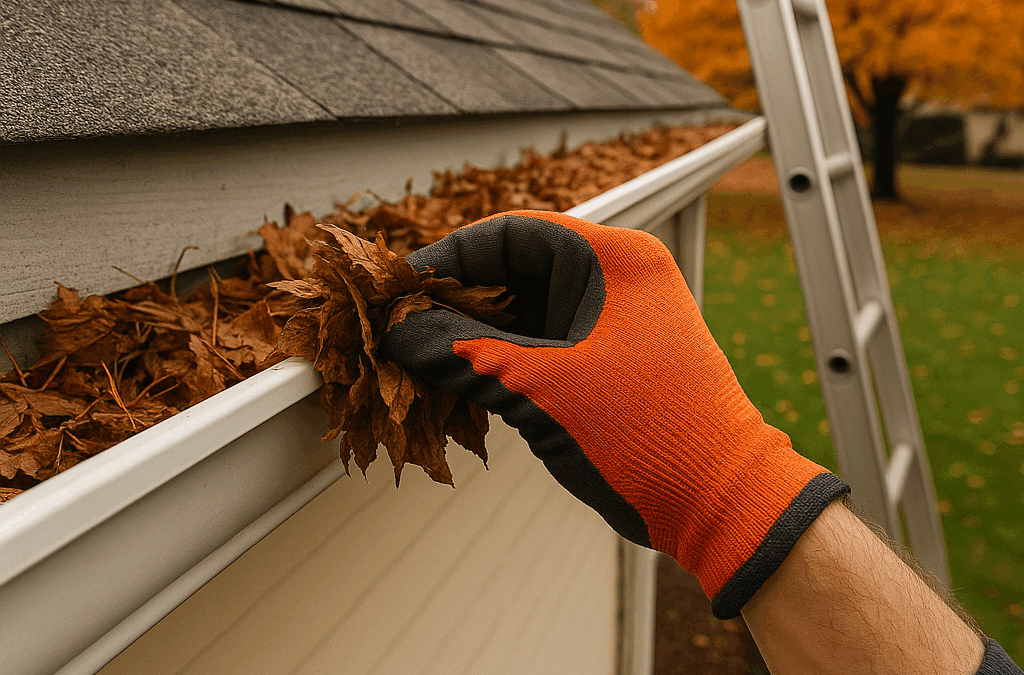
A thorough fall cleaning removes all accumulated debris from every channel section, every downspout inlet, and the full vertical run of every downspout on the property. The compacted organic sediment that accumulates along the channel floor — fine, dark material that is distinct from the loose leaf debris above it — should be removed along with surface debris. This organic sediment retains moisture persistently, contributes biological acids that deteriorate gutter material, and reduces channel flow capacity even when loose debris has been removed.
Downspout inlets warrant specific attention during fall cleaning. Louisville’s sycamore and sweetgum canopy deposits large seed balls and spiky seed pods that are particularly effective at forming blockages at the inlet restriction where the channel feeds into the vertical downspout. Confirming that the inlet is completely clear and flushing the full downspout run from inlet to grade discharge confirms unobstructed drainage through the complete vertical system.
System Flushing and Performance Verification
After debris removal, flushing each channel from its high end toward the downspout with a garden hose provides direct drainage performance verification. This flushing step reveals standing water at sagged channel locations, confirms drainage slope is adequate throughout each run, and verifies that each downspout is draining freely. It also identifies active leaks at joints, end caps, and seams — locations where flushing water exits through the gutter body rather than draining to the downspout outlet — that require sealant repair before winter.
Joint and End Cap Repair
Louisville’s temperature cycling — from sub-zero cold events in severe winter years to 90°F summer peaks — progressively works gutter joint sealants open over each annual cycle. Fall inspection of all joints, end caps, and seams identifies those that have reached the point of active leakage and require resealing before winter. Sealant work performed in fall — on dry, reasonably warm surfaces — bonds more effectively than emergency repairs attempted in cold, wet winter conditions. Any joint showing active leakage, visible separation, or the exterior staining patterns that indicate long-term seepage should be resealed as part of fall preparation.
Hanger and Fastener Inspection
Walking every gutter section and evaluating hanger condition — identifying loose, bent, missing, or inadequately spaced hangers — is an essential fall preparation step for Louisville homes. Loose hangers that have allowed channels to sag should be re-secured where fascia wood integrity permits. Sections with hanger spacing wider than recommended should have additional hangers installed before winter, reducing the channel deflection between mounting points that ice loading amplifies. Hangers that have pulled from deteriorated fascia identify locations requiring fascia assessment and repair before new fasteners can provide reliable holding capacity.
Fascia and Soffit Inspection
The fall cleaning provides the practical opportunity for a visual assessment of fascia and soffit condition. Louisville homeowners should specifically inspect fascia for the early moisture damage signs — paint peeling or bubbling, surface discoloration, probing-detectable softness — that indicate biological deterioration from chronic moisture exposure. Early-stage fascia deterioration identified in fall can be assessed and planned for repair at a time when the work is practical; advanced deterioration discovered after winter conditions have further damaged already-compromised wood is more difficult and expensive to address.
Downspout Discharge Management
Every downspout’s discharge management should be confirmed as properly positioned and functional before winter. Summer lawn maintenance — mowing, trimming, and landscape work — commonly displaces flexible extensions from their intended orientation. Fall is the time to identify and correct any displaced or misdirected extensions, ensuring that every downspout is directing winter rainfall away from the foundation perimeter.
Louisville’s winter rainfall season — November through March, with the year’s highest monthly precipitation totals often occurring in this period — makes foundation perimeter discharge management most consequential during exactly the months that follow fall preparation. Confirming proper discharge positioning before this season begins directly protects Louisville foundations through their most moisture-demanding period.
Underground drainage system outlets — pop-up emitters, grade-level pipes — should be cleared of leaf accumulation from fall’s heavy deposit to ensure free drainage through the winter season. A blocked underground outlet causes backup through the downspout and gutter above during heavy winter rainfall events — creating overflow at the roof level from a ground-level blockage that may not be immediately identified as the source.
Ice and Freeze-Thaw Preparation Specific to Louisville
Louisville’s freeze-thaw cycling and periodic ice storms create winter gutter loading conditions that are more severe than in mid-South cities to the south. Several specific fall preparation actions address these Louisville-specific winter risks.
Hanger Spacing for Ice Loading: Louisville’s ice storms can deposit significant ice weight in gutter channels. Gutter systems with wide hanger spacing — particularly older installations where hangers were spaced at intervals wider than current best practice — are more vulnerable to ice-loading deformation and detachment. Supplementing hanger installations during fall preparation to achieve tighter spacing reduces ice-loading risk during Louisville’s worst winter events.
Gutter Guard Evaluation: Louisville homeowners who have struggled with rapid channel reloading after fall cleanings — particularly those beneath dense sycamore or sweetgum canopy that deposits debris continuously through the fall season — may benefit from evaluating gutter guard installation before winter. Guards that prevent large debris from entering the channel reduce ice formation risk by preventing the debris-ice matrix that forms in blocked channels during freeze events, though guard selection should account for Louisville’s specific debris variety and ice event frequency.
Grade-Level Ice Management: Louisville homeowners with underground drainage systems should confirm that outlet locations are positioned to minimize ice blockage risk during extended freeze periods — outlets at grade level in protected locations or with pop-up emitter designs that minimize freezing risk at the outlet point help maintain system drainage during Louisville’s winter freeze events.
Conclusion
Fall gutter preparation in Louisville, Kentucky is a structured, multi-step process that directly determines the winter performance of the home’s primary water management system. Properly timed cleaning after the bulk of the Ohio Valley canopy drop, thorough system flushing and drainage verification, joint and end cap repair, hanger and fastener evaluation, fascia and soffit assessment, and downspout discharge confirmation together ensure that Louisville gutters enter winter in the condition needed to manage Ohio Valley rainfall, resist freeze-thaw loading, and protect foundations and fascia through the season. Cardinal Gutters recognizes that Louisville homeowners who complete this fall preparation process consistently and thoroughly are investing in the winter protection of their homes and the long-term integrity of the gutter systems and home components that depend on those systems performing well through Louisville’s most demanding seasonal conditions.