In Louisville, Kentucky, the conversation about home foundation health is inseparable from the conversation about water management — specifically, about how effectively the home’s gutter system is managing roof surface runoff and directing it away from the foundation perimeter. Louisville’s Ohio Valley clay soils, its active spring thunderstorm season, and its substantial annual precipitation create a residential environment where the connection between gutter performance and foundation integrity is not abstract or theoretical. It is direct, measurable, and responsible for a meaningful share of the foundation moisture damage, basement water intrusion, and structural deterioration that Louisville homeowners encounter. Cardinal Gutters believes that Louisville homeowners benefit from understanding exactly how gutters protect foundations, what the mechanisms of gutter-related foundation damage are in Louisville’s specific geological and climate context, and what a fully functional gutter system provides for the long-term structural health of a Louisville home.
Louisville’s Foundation Moisture Environment
Louisville’s residential foundation health is shaped primarily by two interacting factors: the Ohio Valley’s substantial rainfall and the clay-bearing soils that characterize much of the metropolitan area’s residential landscape.
Louisville receives approximately 45 inches of annual precipitation, with the seasonal distribution creating a particularly demanding spring period — March through May — during which active frontal systems and developing convective activity deliver some of the year’s highest single-event rainfall totals. These spring rainfall events coincide with the period when clay soils are often already at or near saturation from winter moisture, creating conditions where additional large rainfall deposits have limited soil absorption capacity before reaching the foundation perimeter as surface runoff.
Louisville’s Ohio Valley clay soils are the second and most consequential factor. Clay minerals absorb water and swell when wet, then lose water and contract when dry. This shrink-swell cycle — driven by the amplitude of moisture fluctuations in the soil — exerts lateral and vertical pressure on foundation walls and footings during the swelling phase and creates differential settlement risk during the contraction phase. The amplitude of Louisville’s clay soil moisture cycling at the foundation perimeter is directly influenced by how effectively the gutter system manages roof surface runoff — the largest single controllable source of concentrated moisture deposition at the foundation perimeter on most residential properties.
How Gutters Prevent Foundation Damage
The protective mechanism gutters provide for Louisville foundations operates through a straightforward hydraulic logic: they intercept the roof’s rainfall collection — a large volume of water that would otherwise fall from the eaves in concentrated streams directly adjacent to the foundation — and convey it to discharge points away from the foundation where it can be managed without creating the concentrated perimeter saturation that drives foundation damage.
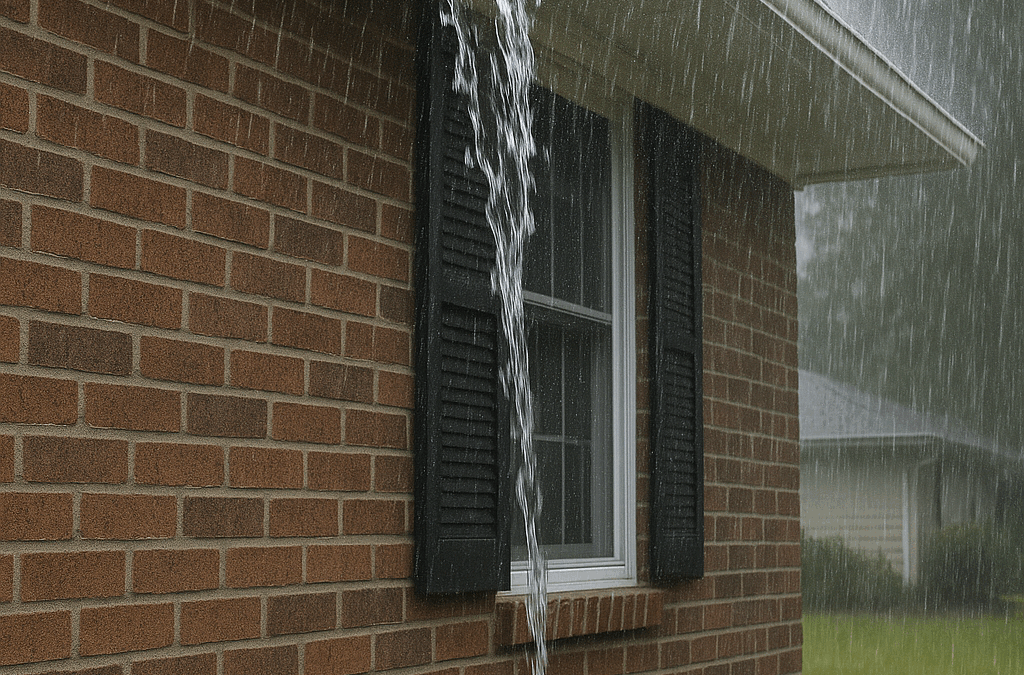
On a typical Louisville home with 1,800 square feet of roof surface, a one-inch rainfall event generates more than 1,100 gallons of runoff. A three-inch rainfall event — not unusual during Louisville’s active spring storm season — generates more than 3,300 gallons from that same roof. Without gutters or with gutters that overflow from blockage and deposit this volume at the foundation perimeter, each of these events subjects the clay soil in direct contact with the foundation to rapid, deep saturation — the saturation that drives the shrink-swell cycling responsible for cumulative foundation stress.
Gutters that collect this runoff and discharge it through properly extended downspouts to points several feet from the foundation replace concentrated perimeter saturation with dispersed discharge at a distance — reducing the intensity and amplitude of moisture cycling in the foundation perimeter soil and providing the stable moisture conditions that minimize the shrink-swell stress Louisville’s clay soils impose on foundations.
The Basement Moisture Connection
Louisville has a substantial population of homes with full or partial basements — a housing characteristic that makes the foundation perimeter moisture management provided by gutters especially consequential. Basement walls are below-grade retaining structures that confine the soil surrounding them on three or four exterior faces. When that surrounding soil is saturated — by gutter overflow, by inadequate downspout discharge management, or by any other surface drainage failure — it exerts hydrostatic pressure against the basement wall that works through every available pathway to move moisture into the below-grade space.
The pathways hydrostatic pressure exploits in Louisville basement walls include: cracks in poured concrete walls, mortar joints in block walls, the wall-footing cold joint, through-wall penetrations, and window well perimeters. Louisville’s older housing stock — the established neighborhoods of the Highlands, Crescent Hill, Cherokee Triangle, St. Matthews, and the historic communities throughout the east end — includes significant populations of older basement homes whose masonry and block walls have the joint conditions that hydrostatic pressure from gutter overflow-driven soil saturation most effectively penetrates.
Basement moisture intrusion in Louisville that correlates with rainfall events — appearing or intensifying after significant spring storms — and that lacks an obvious alternative source such as window well flooding or above-grade wall penetrations is frequently connected to surface drainage management deficiencies, with gutter overflow as a primary contributing factor. Addressing gutter performance as part of basement moisture management is a foundational step — literally — in the comprehensive moisture management of a Louisville basement home.
Crawl Space Implications
Not all Louisville homes have basements — a significant portion of the metropolitan area’s housing stock, particularly smaller and older homes throughout the city and surrounding communities, is built on crawl space foundations. The foundation moisture protection that gutters provide for crawl space homes is as important as for basement homes, though the damage pathway differs.
Foundation perimeter saturation from gutter overflow does not create hydrostatic basement wall pressure in crawl space construction — the below-grade space is ventilated or conditioned rather than enclosed by waterproofed walls. Instead, gutter overflow saturation raises the moisture content of the soil within and adjacent to the crawl space, elevating crawl space humidity to levels that support biological deterioration of the wood structural components above — floor joists, sill plates, girders, subfloor sheathing, and bridging.
In Louisville’s warm, humid Ohio Valley climate, biological wood deterioration in moisture-elevated crawl spaces is not a slow process. The fungi and organisms responsible for wood rot are active throughout Louisville’s long warm season, and floor framing that is persistently exposed to humidity elevated by foundation perimeter saturation from gutter overflow can develop meaningful structural deterioration within a few seasons — deterioration that is invisible from the living space above until it has advanced to the point of floor deflection or structural compromise.
Foundation Grading and the Complete System
The foundation protection that gutters provide is fully effective only when it operates as part of a complete surface drainage system that includes properly graded soil adjacent to the foundation. Proper foundation grading — soil sloping away from the foundation at a sufficient gradient to carry surface water away from the perimeter — ensures that water arriving near the foundation from any source moves away rather than pooling against the foundation walls.
In Louisville’s established neighborhoods, original foundation grading has often been altered by decades of soil settling, tree root activity, landscape modification, and the cumulative effect of foot traffic and maintenance that redistributes soil at the foundation perimeter. Flat or inward-sloping foundation grading — conditions common in older Louisville residential properties — can partially or fully defeat the foundation protection provided by otherwise adequate gutter systems, because water discharged at a distance by extended downspouts may return to the foundation perimeter along inward-sloping grade.
The complete foundation moisture protection system for a Louisville home combines: properly maintained gutters that collect all roof runoff without overflow, downspouts that convey collected water to grade, extensions that discharge it an appropriate distance from the foundation, and properly graded soil that ensures discharged water continues moving away from the foundation rather than returning to the perimeter. Each element is necessary; none is sufficient alone.
Signs That Surface Drainage Is Affecting Foundation Health
Louisville homeowners monitoring for signs of gutter-related foundation moisture stress should watch for these indicators across the property:
Cracks in Foundation and Masonry: Horizontal cracks in block or poured concrete foundation walls may indicate lateral pressure from expanding clay soil. Diagonal or stair-step cracks in brick or block masonry may reflect differential settlement. These patterns, appearing or worsening during wet seasons, warrant evaluation of surface drainage management as a contributing factor.
Seasonal Sticking Doors and Windows: Doors and windows that bind or stick during and after Louisville’s wet spring season and improve during summer’s drier periods may reflect seasonal foundation movement consistent with clay soil shrink-swell cycling amplified by inadequate foundation perimeter moisture management.
Basement Wall Efflorescence and Moisture: White mineral deposits on basement wall surfaces, water staining at wall bases, or recurring dampness at the wall-floor junction during wet seasons indicate water migration through basement walls from saturated exterior soil. These conditions warrant evaluation of gutter performance and downspout discharge management as contributing factors.
Landscape Erosion Adjacent to Foundation: Bare or eroded soil, displaced mulch, or erosion channels in planting beds adjacent to the foundation — particularly concentrated near downspout discharge locations — provide direct evidence of the concentrated water deposition that is saturating foundation perimeter soil.
Crawl Space Humidity and Biological Growth: Elevated humidity, biological staining on wood surfaces, or signs of wood deterioration in the crawl space during or after wet seasons indicate that surface drainage conditions are contributing to crawl space moisture elevation. Gutter performance and discharge management should be evaluated as primary contributing factors.
The Long-Term Value of Foundation Protection
Louisville real estate values reflect foundation condition prominently. Homes with documented foundation issues face the most significant disclosure, inspection, and negotiation challenges in the Louisville residential market. The cost of foundation remediation — crack injection, interior drainage systems, exterior waterproofing, underpinning — is substantial and the disruption of the remediation process significant. Against these costs, the investment in maintaining a gutter system that consistently protects the foundation perimeter from concentrated runoff deposition is, over the service life of the home, among the most economical structural protection investments Louisville homeowners can make.
Conclusion
The role of gutters in protecting Louisville, Kentucky home foundations is direct, consequential, and grounded in the specific interaction between Ohio Valley rainfall, Louisville’s clay soils, and the hydraulic demands of managing roof surface runoff away from the foundation perimeter. Functional gutters prevent the concentrated soil saturation that drives clay soil shrink-swell stress, the hydrostatic pressure that drives basement moisture intrusion, and the crawl space humidity that drives floor framing deterioration — protecting the structural integrity of Louisville homes across all four seasons of the Ohio Valley’s demanding climate. Cardinal Gutters recognizes that Louisville homeowners who understand this foundational connection and maintain complete, properly functioning gutter systems are protecting not just their gutters but the stability, integrity, and long-term value of the foundation upon which everything else in their home depends.